
By: Brian G. Chilton, Ph.D. | August 9, 2026
Recently, we have received a lot of fantastic questions at Bellator Christi. One question seems to keep resurfacing from various individuals, and that is this: What are the Biblically permissible grounds for divorce and remarriage?
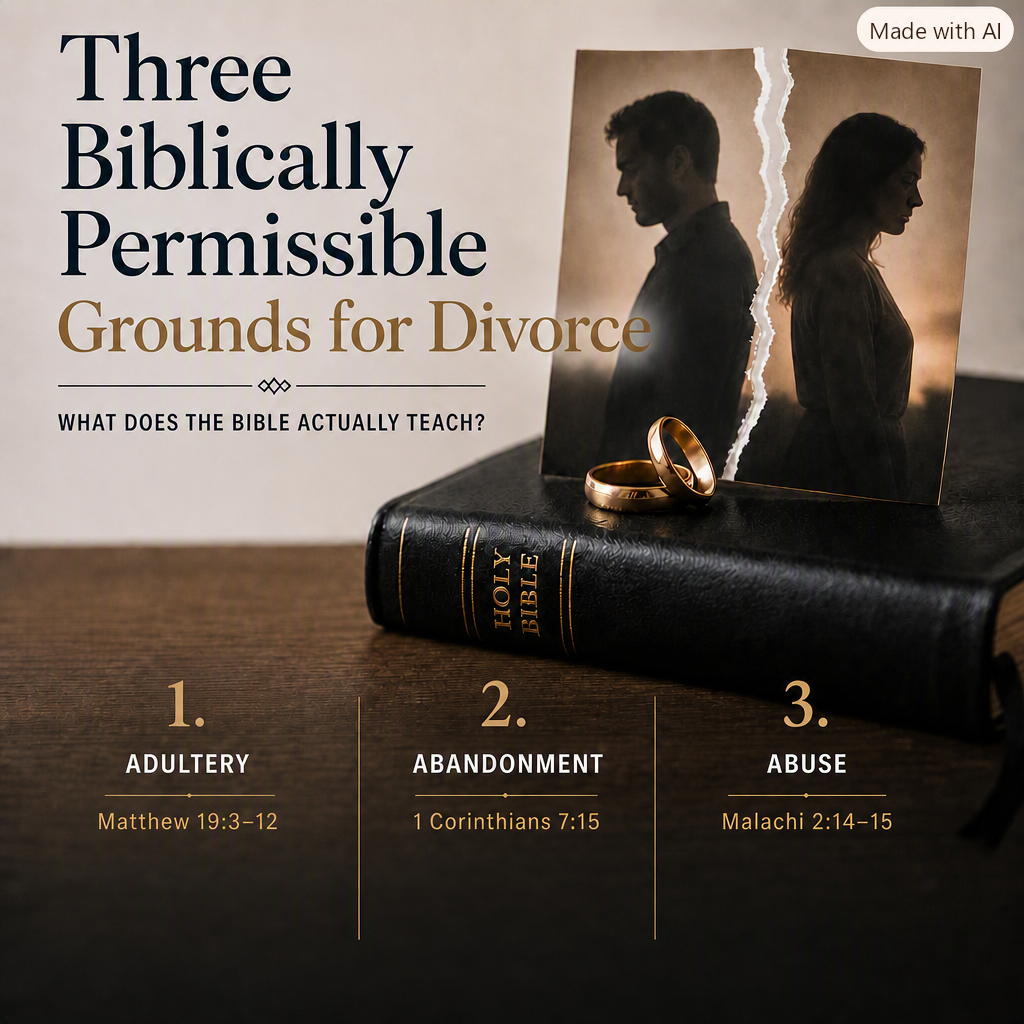
One of the caveats I always want to give to conversations like these is that these grounds constitute permissibility, not a requirement. The primary goal for marriage is to make it a lifetime with one’s partner and not to dissolve the union. As Scripture states, “What therefore God has joined together, let not man separate” (Matt. 19:6, English Standard Version). Therefore, just because the Bible permits the dissolution of a marriage under the following circumstances, it is not required. If counseling and restitution can be made, that should be the primary obligation. However, if the relationship cannot be restored, then these three areas make the dissolution permissible. So far as I can tell, the Bible permits divorce under three circumstances, all of which begin with the letter “A.”
Adultery is a Biblically Permissible Ground for Divorce (Matt. 19:3–12).
Adultery is the first and clearest grounds for divorce. Jesus interacts with the Pharisees once he entered Judea (Matt. 19:1–2). The Pharisees were already embroiled in a bitter debate concerning the issue of divorce. Their debate stemmed from an argument among two of their most respected rabbis: Hillel and Shammai.
Hillel, the more progressive of the two, interpreted Moses’s permission of divorce in Deuteronomy 24:1–4 to say that a man could divorce his wife for any cause, including if he were to find a younger model or if his wife burned his biscuits. In stark contrast, Shammai, the more conservative of the two, stated that a man could only divorce his wife on valid grounds, such as adultery.
Jesus pointed the debate back to God’s original intentions for marriage. God intended for a husband and wife to remain joined together for life (Matt. 19:8). However, due to the entrance of sin and the hardness of hearts, God allowed certain permissions to those who were wronged. Adultery is one such permissible cause (Matt. 19:9).
But what is the scope of adultery? Matthew uses the term πορνεία (porneia) for the word “adultery.” Πορνεία holds a wide range of meanings. The most implicit meaning is when one party cheats on the other party. In such a case, the innocent party is freed from the consequences of the moral indiscretion, seeing as they were the one who remained faithful. But many, such as John Feinberg, have noted that the term could also refer to broader sexual indiscretions such as incest, fornication, alternate lifestyles, and bestiality.[1] In all cases, the partner has left the fidelity of the marital partnership, thus leading to a morally acceptable divorce. Hence, the innocent party is freed to remarry without any moral consequence, at least spiritually speaking.
Abandonment is a Biblically Permissible Ground for Divorce (1 Cor. 7:10–16).
Paul offers a second Biblically permissible case for divorce. In 1 Corinthians 7, he addresses the case for abandonment being grounds for divorce. The chapter begins with a call for men and women to marry so that each person can give oneself to their partner (1 Cor. 7:1–5). After a few marital instructions, Paul then confesses that he remains single to wholly devote himself to the Lord’s work (1 Cor. 7:6–7).
Then, in verses 12 and following, Paul discusses what should happen if an unbelieving partner abandons a believer. Paul first argues that it is best if the couple can remain married. It may be that the believer’s faith might rub off on the unbeliever. The Lord can use their faith to bring the unbeliever to salvation. Paul admits that this occurs in an ideal situation, but this is not always the case.
He continues by showing what should happen if an unbeliever abandons the believer due to their faith. If abandonment should occur, it is best to permit a divorce to occur because “God has called you to peace” (1 Cor. 7:15). Therefore, since God desires peace in the home, it is better to separate when the partner abandons the marriage and let him or her go.
Abuse is a Biblically Permissible Ground for Divorce (Exod. 21:10; 1 Cor. 7:15/Mal. 2:14–15; Eph. 5:28–29).
Abuse is the third permissible ground for divorce. However, this reason requires a bit of hermeneutical explanation, as it is not as clear-cut as the other two. Therefore, a case must be made for abuse.
Spousal obligations are laid out in Exodus 21:10. A husband is to provide his wife with food, clothing, and her marital rights (Exod. 21:10). Failure to do so could constitute abuse and would free her from their marital obligations.[2] This framework suggests that physical or emotional abuse constitutes a fundamental breach of one’s covenantal duties as a spouse. In this case, just as David left Saul’s court when abuse occurred, the abuser destroys their covenantal agreement to “love and to cherish as long as they both shall live.”
We already looked at Paul’s abandonment passage in 1 Corinthians. But also consider the text’s connection with Malachi 2:14–15. The prophet spoke to the abuse that occurred in many homes of his day, saying, “the LORD was witness between you and the wife of your youth, to whom you have been faithless, though she is your companion and your wife by covenant. Did he not make them one, with a portion of the Spirit in their union? And what was the one God seeking? Godly offspring. So guard yourselves in your spirit, and let none of you be faithless to the wife of your youth” (Mal. 2:14–15). He then says that the guilty abuser who caused the divorce covers his garments with violence (Mal. 2:16) before powerfully admonishing the people to stop calling evil good and good evil.
Finally, Paul also gives a model for a good marriage. The wife lovingly submits herself to her husband (Eph. 5:22–24), while the husband loves his wife as Christ loves the church (Eph. 5:28–29). But what does it mean to “love someone like Christ loves the church”? It means to give sacrificially to the other person, ensuring that every need is met. Since the two are joined together, the one who “loves his wife loves himself” (Eph. 5:28) and “nourishes and cherishes it, just as Christ does the church” (Eph. 5:29). Therefore, there is no call for abuse in the home.
Synthesizing the truths from these Scriptures, the following argument can be made:
- Biblical marriage is a covenant grounded in love.
- Covenant-breaking actions permit the dissolution of the marital covenant.
- Abuse is a covenant-breaking action because it violates biblical love.
- Therefore, abuse dissolves the marriage covenant.
- Therefore, divorce is Biblically permissible in cases of abuse.
Conclusion
Circling back to the caveat given in the introduction, marriage is a serious covenantal agreement that should be entered into with the greatest caution, the utmost prayer, and Spirit-led convictions. God’s desire is for couples to be united for a lifetime commitment of love, devotion, and rearing future generations of Biblically minded individuals. Quite frankly, modern Christians are abysmally failing God, our children, and our nation by our failure to get things right in the home. Now more than ever before, I believe the failures of our nation are directly connected with the breakdown of the home. Therefore, as I always do, I take the position Jesus held. Our primary focus should be back on the initial intentions God had for marriage in the first place.
However, humanity is a fallen race living in a fallen world. Sin ruins everything, including marriages. As much as we would hope to, we cannot change another person’s mindset outside of the Holy Spirit’s convicting power. And if God desires peace in the home and peace in our lives, then divorce may sometimes be inevitable when one party remains adulterous, abandons their marital bonds, or engages in physical and/or emotional abuse. In such cases, the innocent party is released from the bonds of their broken covenantal agreement. Nonetheless, offended parties should consult their pastors, counselors, and trusted friends when making such a decision. Most importantly, the offended party must soak such a decision in prayer and follow the leadership of God.
About the Author
Brian G. Chilton, M.Div., Ph.D.

Dr. Brian G. Chilton (PhD, Liberty University) is the founder of Bellator Christi Ministries and the co-host of the Bellator Christi Podcast. He serves as a hospice chaplain and an Adjunct Professor of Apologetics for Carolina College of Biblical Studies, a Dissertation Mentor/Adjunct Professor for Liberty University in the PhD in Applied Apologetics program, and an Adjunct Professor/Dissertation Reader at Carolina University in the DMin program. Dr. Chilton's primary area of research is on early Christianity, oral traditions, NT creeds, the blend of divine sovereignty and human freedom, and near-death experiences (NDEs).
Bibliography
[1] John S. Feinberg and Paul D. Feinberg, Ethics for a Brave New World (Wheaton, IL: Crossway, 1993), 308–309.
[2] Ramona Probasco and Ray McElroy, Healing Well and Living Free from an Abusive Relationship: From Victim to Survivor to Overcomer (Grand Rapids, MI: Revell, 2018), Kindle.