
By: Brian G. Chilton, MDiv, PhD | November 15, 2026
Literary observations matter when interpreting the Bible. As famed apologist Greg Koukl has been noted to say, “Never read a Bible verse.”[1] Instead, read at last a paragraph. The idea is that verses can be made to say anything one chooses when taken out of the context of the paragraph. The goal is to keep the main message in hand. Likewise, biblical writers often employed patterns and tactics that emphasized certain truths. Some of these patterns may have held mnemonic value, helping individuals memorize main components of the book. Others literary devices are used to teach certain key themes.
One literary device that is of importance is the chiasm. Interestingly, many scholars have noticed a chiastic pattern in the book of Revelation. If this holds true, the centerpoint of the chiasm is of special importance. This article argues that such a pattern potentially exists in the book of Revelation and the centerpoint offers encouragement to those who are worried about the end times.
What is a Chiasm?
A chiasm or chiasmus stems from the Greek letter chi, which has the shape of an X (χ). Chiasms take a form that can be visually identified as A-B-A’, or A-B-C-B’-A’. Harry Hoffner explains that the device “not only gives a certain poetic or artistic appearance to the narrative, but it also may provide the narrator’s own clue to the central element being highlighted.”[2] It is said that chiasms rank among the most frequently identified literary devices in Old Testament literature,[3] but they are oddly lacking in Greek literature.[4] OT examples include the Book of Lamentations, 1 & 2 Samuel, and throughout prophetic literature. Interestingly, though chiasms are not largely found in Greek writings (as previously noted), some chiasms have been identified in the NT.
What is the Chiasm of Revelation?
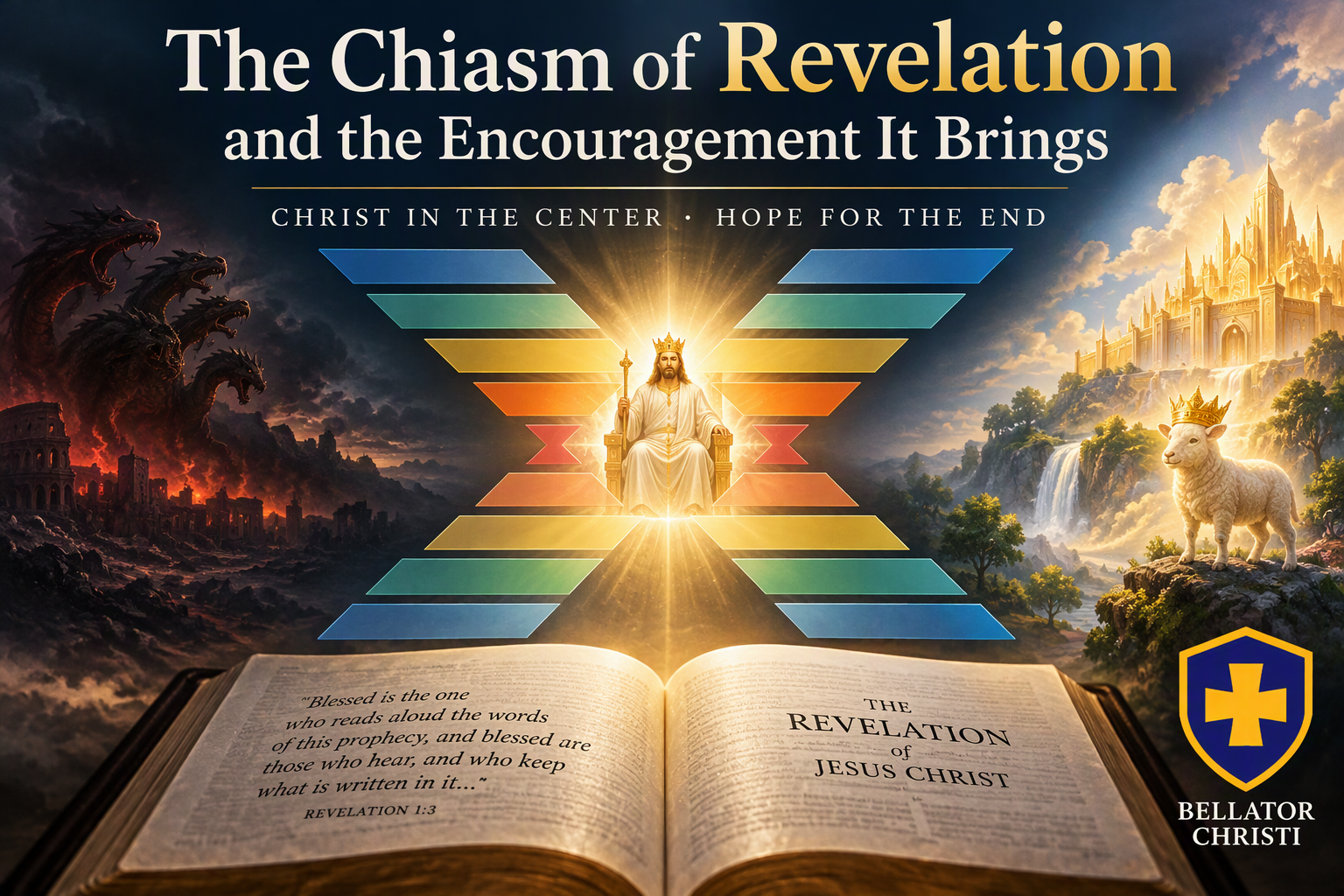
Elisabeth Schussler Fiorenza and John M. Court discovered a potential chiastic pattern in Revelation.[5] A simplified version of the proposed chiasm is as follows:
- A: Prologue and Greeting (1:1–8).
- B: Vision of Christ and Seven Churches (1:9–3:22).
- C: Seven Seals (4:1–8:1).
- D: Seven Trumpets (8:2-11:19).
- E: Seven Visions (12–15:1).
- D’: Seven Bowls of Wrath (15:2–16:17).
- D: Seven Trumpets (8:2-11:19).
- C’: Seven Condemnations of Babylon (16:1–19:10).
- C: Seven Seals (4:1–8:1).
- B’: Seven Visions of Christ’s Kingdom (19:11–22:5).
- B: Vision of Christ and Seven Churches (1:9–3:22).
- A’: Epilogue and Final Exhortation (22:6–21).
If this chiasm holds, as it seems to, then the centerpoint of Revelation is in the seven visions found in chapters 12–14. Additionally, chapter 12 is of special importance as it steers the content of the seven visions. That is, these visions serve as the interpretive key for the entire book.
What Encouragement Does the Centerpoint of Revelation Bring?
The centerpoint of the possible chiasm in Revelation is found in the seven visions of Revelation 12–15:1. These visions are set apart by the introductory formula “and I saw” or “and I behold.” The seven visions include the following:
- the conflict between the dragon and the woman with Child (12:1–);
- the persecution by the beast of the sea (13:1–10);
- persecution by the beast of the land (13:11–18);
- the Lamb and the 144,000 standing on Mount Zion (14:1–5);
- the proclamation of the gospel by three angels (14:6–13);
- the Son of Man’s harvest of the earth (14:14–20); and
- the saints’ victory over the sea and land beasts (15:2–4).
Visions 2–7 are all important, but they seem to follow the main points of the first vision of chapter 12. To understand the encouragement these visions bring to the believer, let us first identify the key players of chapter 12.
Players of the Vision
The first two players are the most easily identifiable. The Child points to the Messiah Jesus of Nazareth. The dragon is easily identified as Satan. Revelation 12 points back to Genesis 3, where the seed of Eve does battle with the serpent in the Garden.[6] This serpent also hurled a third of the stars in heaven to earth, pointing to the deception he brought that led a third of the angels of heaven in rebellion against God.
But who is the woman? It is easy to identify the woman with Mary the mother of Jesus, and to a degree this is true. However, the woman represents a group of people larger than Mary alone. The woman points to the community from which the Messiah appeared. That is, the woman represents the saints of God—believers from all generations.
The Narrative of the Vision
With the key players identified, we can then follow the train of thought more precisely. The dragon tried to destroy the birth of the Child, pointing to the slaughter of the innocents by King Herod (Matt. 2:7–18) and the holy family’s flight to Egypt.
The woman gave birth to a Son who will “rule all nations with an iron rod” (Rev. 12:5, Christian Standard Bible). The dragon came after the Child, but he could not overcome Him because the Child was “caught up to God and to his throne” (Rev. 12:5). This refers to the resurrection and ascension of Jesus, particularly the latter.
Incensed that he could not defeat the Child, the dragon directs his attention to the woman—that is, the saints of God. The woman fled into the wilderness, much like the Hebrews were in the wilderness for 40 years, pointing back to Exodus. She is there for 1,260 days. While we do not know for exactly 1,260 days is, the allusion points back to Daniel 12:11.
A war then breaks out in heaven in which Michael and his angels cast out the dragon and his angels (12:7–8). The dragon could not win against the Child, and he could not win against the might of God’s angels, so the dragon directs his attention exclusively on the woman (the saints of God). The dragon persecutes the woman until the time the woman is given “two wings of a great eagle, so that she could fly from the serpent’s presence to her place in the wilderness” (12:14).
The dragon becomes furious. He cannot win against God and His Child. He cannot win against the angels of heaven. And he cannot win against the saints of God. So, the dragon then attacks the rest of the woman’s offspring. The other offspring is a matter of great speculation. Could it refer to those saved during the time of tribulation? Possibly. We just do not know for sure. Nevertheless, chapters 13–15:1 lay the groundwork for how these attacks occur.
The Encouragement the Vision Brings
At this point, we should circle back to the initial question brought about by this section: What encouragement do we find in this section? There are several encouragements we find. First, God has laid out His gameplan for how He intends to overcome evil. The dragon wages war against God and His people. However, he is never victorious. Yes, he brings all kinds of problems. But the victory belongs to God. Can you imagine a football coach developing a playbook and letting the opposing side see how he plans to win? That is exactly what God has done. The victory had already occurred at the cross and an empty tomb. The final victory comes when God through His saints conquers him by the “blood of the Lamb” (Rev. 12:11).
Second, understand that much of the problems of our time stem from this cosmic battle occurring all around us. Neither Democrats nor Republicans are our enemies. The enemy is neither Jew nor Arab. Iranians, Russians, and Muslims are not our enemies. Our enemy is Satan and his demonic horde. Jesus said that Satan is a “murderer from the beginning and does not stand in the truth, because there is no truth in him. When he tells a lie, he speaks from his own nature, because he is a liar and the father of lies” (Jn. 8:44–45). The force steering misinformation, desires to kill, divisions, and discord is none other than the ancient Serpent of old. In contrast, God is unchanging truth and “cannot lie” (Titus 1:2). God can be trusted; Satan can't.
Finally, a day is coming when this cosmic battle will end. That day will come when God completely and totally imprisons the serpent and his horde for all eternity. The satanic virus is quarantined and separated from those who love God and desire to follow Him. Peace will come. But that peace will not come from governmental authorities or policies. Rather, peace will come from the Prince of Peace who overcomes the world.
Conclusion
Craig Keener notes that Revelation 12 is the “centerpiece of Revelation and the centerpiece of its review of history; no one other than our Lord Jesus Christ may fill that role.”[7] Keener is spot on in his assessment. It is true that we live in scary times. However, believers can find rest in that God is not taken by surprise. We all find ourselves in fascinating times in history. We do not know what will come in the upcoming years. But if you are in Christ, you know who holds the future.
About the Author
Brian G. Chilton, M.Div., Ph.D.

Dr. Brian G. Chilton (PhD, Liberty University) is the founder of Bellator Christi Ministries and the co-host of the Bellator Christi Podcast. He serves as a hospice chaplain and an Adjunct Professor of Apologetics for Carolina College of Biblical Studies, a Dissertation Mentor/Adjunct Professor for Liberty University in the PhD in Applied Apologetics program, and an Adjunct Professor/Dissertation Reader at Carolina University in the DMin program. Dr. Chilton's primary area of research is on early Christianity, oral traditions, NT creeds, the blend of divine sovereignty and human freedom, and near-death experiences (NDEs).
Notes
[1] Greg Koukl, “Never Read a Bible Verse,” STR.org (Feb. 4, 2013), Never Read a Bible Verse - Stand to Reason.
[2] Harry A. Hoffner, Jr., 1 & 2 Samuel, Evangelical Exegetical Commentary (Bellingham, WA: Lexham, 2015), 1:34–35.
[3] Hoffner, 1 &2 Samuel, 1:34–35.
[4] Gary W. Derickson, First, Second, and Third John, Evangelical Exegetical Commentary (Bellingham, WA: Lexham, 2012), 714.
[5] Donald Guthrie, New Testament Introduction (Downers Grove, IL: IVP, 1996), 972–973; John M. Court, Revelation (Sheffield: Sheffield Academic, 1999), 85–86.
[6] See Genesis 3:15.
[7] Craig Keener, Revelation, NIV Application Commentary (Grand Rapids, MI: Zondervan, 1999), 12:5–6.