
Dr. Leo Percer | August 2nd, 2026
One of the greatest gifts Christians receive is freedom in Christ. Through Jesus, we are no longer slaves to sin, fear, or condemnation. Yet the Apostle Paul teaches us in 1 Corinthians 10:23–11:1 that Christian freedom is not only about what we are allowed to do. Rather, it is about how we use that freedom to love God, serve others, and help people come to know Christ.
Paul wrote to the church in Corinth, a city filled with competing ideas, religions, and lifestyles. The Corinthians struggled with many of the same issues believers face today. They asked questions such as: “What am I free to do?” “How should I relate to people who do not share my beliefs?” and “How can I live faithfully in a culture that often opposes Christianity?”
Paul’s answer is simple but challenging: “With great freedom comes great responsibility.”[1]
Christian apologetics is often thought of as debates, arguments, or intellectual discussions. While apologetics may include these, Paul teaches that one of the strongest defenses of Christianity is a life marked by humility, love, and healthy relationships. People often watch our lives before they listen to our words.
Paul gives us four important principles for living out our faith in a way that strengthens relationships and points people to Jesus.
Freedom Must Be Guided by Love (1 Cor. 10:23-24)
Paul begins by quoting a saying popular among the Corinthians: “Everything is permissible.” Some believers believed that because they were saved by grace, they could do whatever they wanted. They thought grace exempted them from boundaries. While Paul does not strictly reject this assertion of freedom (exestin, meaning rights or liberty), he immediately introduces vital ethical exceptions. He counters that not everything is beneficial (sympherei, meaning advantageous), and not everything builds others up.[2] Paul adds an important qualification: “Not everything is beneficial,” and “Not everything builds others up.” Paul highlights the concept of oikodomeo (the Greek word for building or edification). In classical architecture, it refers to the process of raising a structural foundation. Paul applies it relationally: our moral freedom must actively construct the spiritual lives of those around us.[3]
This principle applies just as much today as it did in Corinth. While Christians have freedom in many areas, they should ask:
- Does this help others?
- Does this strengthen my witness?
- Does this honor Christ?
- Will this build relationships or damage them?
Our culture often tells us to put ourselves first. The gospel teaches the opposite. Jesus consistently placed the needs of others before his own. If we want to be effective witnesses for him, we must do the same.
For example, social media gives tremendous freedom. We can share our opinions instantly with hundreds of people. Yet having the right to post something does not mean we should. A harsh comment or an angry post may win an argument while losing an opportunity to share Christ. Restricting our digital freedom—by pausing before typing, filtering words through love, and prioritizing peace over winning an argument—builds a foundation that values human souls over social media engagement. Christian freedom is at its best when it is motivated by love.
Build Bridges, Not Walls (1 Cor. 10:25-30)
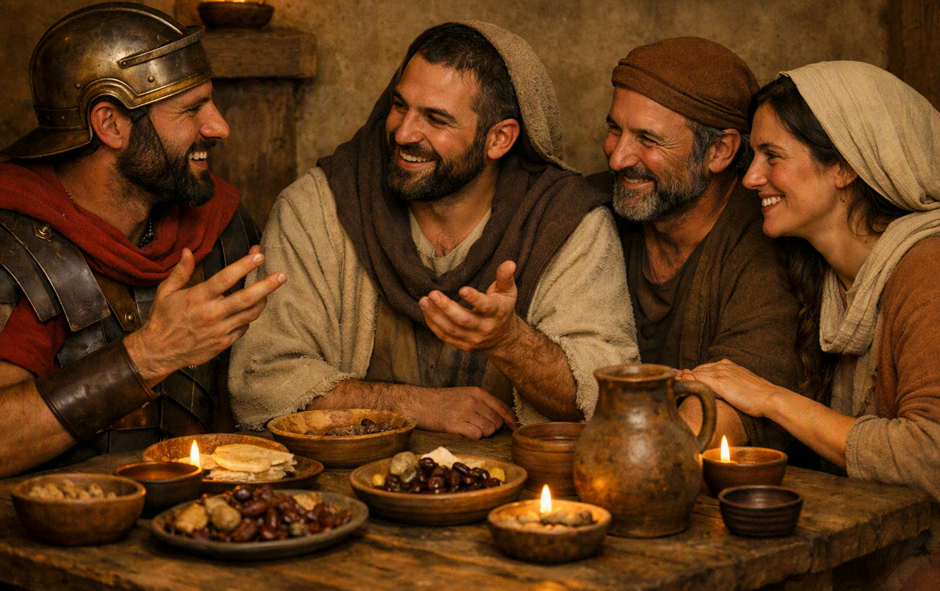
Paul then addresses the issue of eating meals with unbelievers. He tells the Corinthians that if they are invited to dinner, they should graciously accept the invitation and enjoy the meal without interrogating their hosts. This may seem like an unusual topic, but the principle behind it is incredibly relevant: relationships matter.
Too often Christians approach non-believers as projects instead of people. We become so focused on correcting behavior that we forget to build trust. Paul encourages believers to engage the world with grace and humility. This passage contains a radical principle for relational evangelism when dealing with non-believers: prioritize connection over correction.[4] Believers are called to extend the grace that God has shown them. Apologetics is not only about having good answers; it is also about building good relationships.
Consider Jesus. He spent time with tax collectors, sinners, and outsiders. He listened to people. He ate with them. He showed compassion. His relationships opened the door for conversations about God’s Kingdom.
Many people today have never read the Bible, but they have met Christians. Their opinion of Christianity is often shaped by those interactions. Imagine receiving an invitation from neighbors who do not share your values. One response is to avoid them entirely. Another is to attend, show kindness, and genuinely care about their lives. The second approach creates opportunities for future conversations about faith. People are more likely to listen to the gospel when they know they are loved.
Put Others Before Yourself (1 Cor. 10:28–30)
Paul introduces another important principle: Christian freedom should never become a stumbling block for others. Christians have immense freedom, but Paul reminds us that we may need to limit our own freedom to benefit others.[5] Our culture, which celebrates personal rights, makes this difficult. Yet Jesus demonstrated that true greatness is found in sacrifice.
Think about issues Christians often disagree on today—entertainment choices, social activities, or other matters of personal conviction. The question is not always, “Can I do this?” Sometimes the better question is, “Should I do this, especially if it harms someone else?”
Paul reminds us that being “right” is not the goal. Being like Christ is the goal. We should pursue righteousness over being “right.”[6] This principle is especially important in apologetics. Winning an argument is not the same as winning a person.
Many Christians can explain complex theological ideas, but fewer know how to listen well, show compassion, or patiently walk alongside someone who has doubts or disagreements. Effective apologetics combine truth and love. The goal is not merely to prove Christianity is true—although it is. The goal is to help people encounter the risen Messiah.
When we willingly limit our freedoms for the good of others, we demonstrate the heart of Jesus. That kind of humility speaks powerfully in a world consumed with self-interest.
Live for the Glory of God (1 Cor. 10:31-11:1)
Paul concludes with one of the most famous statements in Scripture: “Whether you eat or drink or whatever you do, do it all for the glory of God.” Everything in the Christian life ultimately points back to God. Our relationships, conversations, decisions, and actions should help others see him more clearly.
Paul warns believers not to become obstacles that prevent people from seeing Jesus.[7] Sometimes Christians unintentionally damage their witness through pride, arrogance, or unnecessary conflict. The gospel itself can be offensive because it calls for repentance. However, our attitudes should never add to that offense.
Humility is one of the strongest apologetic tools available to believers. In a world marred by self-promotion and competitive covetousness, humility stands out. In a culture filled with division, kindness stands out. In an age of hostility, grace stands out. When Christians respond to criticism with patience, serve others without expecting recognition, and consistently demonstrate the love of Christ, people take notice. Our lives become living evidence that Jesus changes people.
Paul concludes, “Follow my example, as I follow the example of Christ.” Here is a challenging question for every believer: Could we honestly say the same thing?
Conclusion
Christian freedom is not the right to do whatever we want. It is the privilege of becoming more like Jesus. People are watching our lives every day. They notice how we speak, how we treat others, and how we respond under pressure. Long before they hear our theology, they experience our character.
If we want to be effective in apologetics, we must remember that relationships matter. We are called to build bridges, serve others, and live with humility. The world does not need more arguments for the sake of arguments. It needs Christians who genuinely love people and faithfully point them to Christ.
With great freedom comes great responsibility.
The present age worships prestige, position, and power, but the kingdom of heaven esteems humility, service, and selfless living. May we use our freedom wisely by loving others, glorifying God, and helping a broken world see Jesus more clearly.
About the Author
Leo Percer, Ph.D.: Academic Advisor to Bellator Christi Ministries, Publication Editor, and Contributor
 Leo Percer grew up in Millington, Tennessee, northeast of Memphis, when he first received his call to teaching ministry. He has been involved in numerous ministerial activities, including serving as an elder at Forest Community Church in Forest, Virginia. Dr. Leo Percer graduated with a Ph.D. from Baylor University, an M.A. from Western Kentucky University, and M.Div. from the Southern Baptist Theological Seminary, and a B.A. from Union University.
After graduating with his Ph.D., Dr. Percer has taught at Baylor University, McLennan Community College, and Liberty University, where he served as the Director of the Ph.D. in Theology and Apologetics program for years. His area of expertise is in Second Temple Judaism, the Epistles of Paul, and apocalyptic literature. Dr. Percer is an active member of the Evangelical Theological Society, the Society of Biblical Literature, and is on the board of directors at Ratio Christi. Dr. Percer resides in Lynchburg, VA, with his wonderful wife, Lisa, and two children. He loves reading, collecting comic books, and is a coffee connoisseur.
References
[1] With apologies to Stan Lee and Steve Ditko, the creators of Spider-Man.
[2] Anthony C. Thiselton, The First Epistle to the Corinthians: A Commentary on the Greek Text, New International Greek Testament Commentary, Grand Rapids, MI: W.B. Eerdmans, 2000), 781.
[3] Roy E. Ciampa and Brian S. Rosner, The First Letter to the Corinthians, Pillar New Testament Commentary (Grand Rapids, MI; Cambridge, U.K.: William B. Eerdmans Publishing Company, 2010), 485.
[4] Mark Taylor, 1 Corinthians, ed. E. Ray Clendenen, vol. 28, The New American Commentary (Nashville, TN: B&H Publishing Group, 2014), 247.
[5] Anthony C. Thiselton, The First Epistle to the Corinthians: A Commentary on the Greek Text, New International Greek Testament Commentary (Grand Rapids, MI: W.B. Eerdmans, 2000), 791.
[6] Roy E. Ciampa and Brian S. Rosner, The First Letter to the Corinthians, The Pillar New Testament Commentary (Grand Rapids, MI; Cambridge, U.K.: William B. Eerdmans Publishing Company, 2010), 498.
[7] Mark Taylor, 1 Corinthians, ed. E. Ray Clendenen, vol. 28, The New American Commentary (Nashville, TN: B&H Publishing Group, 2014), 250.