

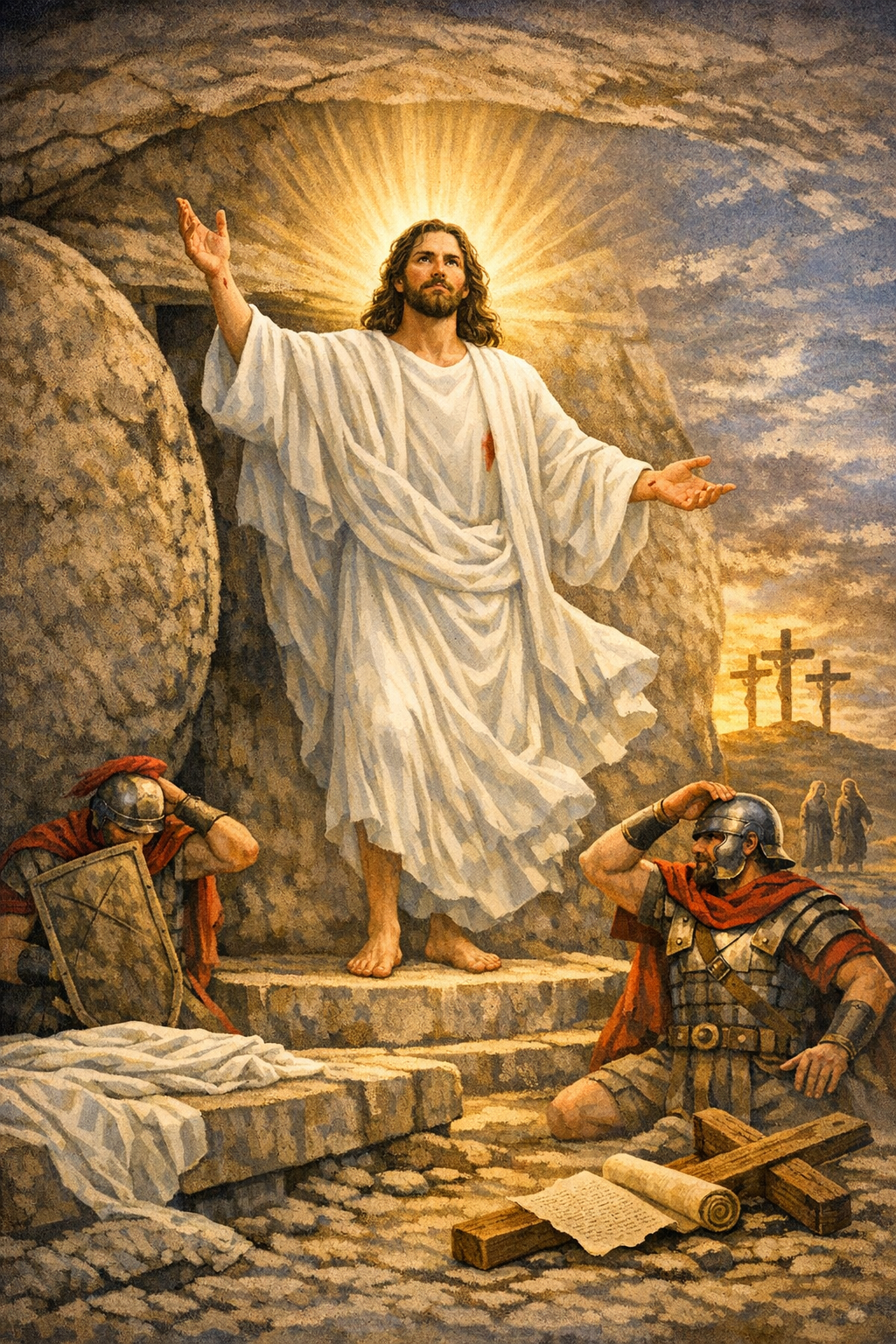
By: Brian G. Chilton, PhD | April 5, 2026 (Easter Sunday)
Happy Easter! As the angels proclaimed to the women at the tomb, their words ring just as true nearly 2,000 years later, “You are looking for Jesus the Nazarene, who has been crucified. He has risen; He is not here; see, here is the place where they laid Him” (Mk. 16:6, NASB).
Reflecting on Easter this year is especially important as it likely aligns with the actual date of Jesus’s resurrection on April 5, 33 AD. As normally happens, the skeptics come out of the woodwork to offer their rebuttal to this miraculous occurrence. However, I would like to leave you with a simple acronym to defend the resurrection of Jesus based on some of the best evidence we have for the resurrection itself. Remember the acronym RISEN. I used this acronym in my book Layman’s Manual on Christian Apologetics and as a contribution to the book Strong Faith. Later, I hope to develop the acronym even more. But for now, consider the five evidential points of RISEN.
R = Records of Jesus’s Crucifixion and Resurrection
The records for Jesus’s life, death, and resurrection are nothing short of astonishing, especially when considering that Jesus was an itinerant preacher and not an earthly king. No less than 20 independent sources mention that Jesus lived, was crucified, and was seen alive by His disciples. These records include, but are not limited to, the four Gospels, the thirteen Epistles traditionally ascribed to Paul, Clement of Rome (95 to 96 AD), Ignatius’s Letter to the Smyrneans (107–115 AD), Polycarp’s Letter to the Philippians (110–140 AD), Justin Martyr’s On the Resurrection (150–160 AD), Tacitus (64 AD), Josephus’s Antiquities of the jews (80 AD), Suetonius (120 AD), Pliny the Younger (111–113 AD), Lucian of Samosota (165 AD), Thallus (55 AD), Celsus (175 AD), and Mara bar Serapion (70 AD).[1] If you counted alongside me, you noticed that when including the biblical texts, we have close to 30 independent sources that mention Jesus and His resurrection. Note that not all of the nonbiblical sources were listed. At least 20 nonbiblical sources mention Jesus, which skyrockets the number to well over 30. In antiquity, only emperors and generals hold that kind of evidential backing.
I = Irritating Details (or Embarrassing Details)
These are details that the proclaimers of the Christian faith would not have invented. Several irritating details could be described, but for the sake of space, we will mention three. First, it was an irritating and embarrassing fact for the early church that women served as the first witnesses of the resurrection when living in a patriarchal society that valued the testimony of men. In fact, the very first witness, Mary Magdalene, was a woman who had been exorcised of seven demons (Lk. 8:2; Mk. 16:9). With all due respect to Mary Magdalene, if you were inventing a story, she would have been the last person you would have offered as the first witness to such an amazing and critical event.
Second, the fact that the disciples could not offer Jesus a proper burial was very embarrassing for them in an honor/shame culture. Joseph of Arimathea was a good and righteous man. He was a member of the Sanhedrin, the very same council that condemned Jesus. However, he had not consented to their plans and actions (Lk. 23:50). Even still, Joseph, a wealthy and educated man, risked everything to give Jesus a proper burial. In fact, all four Gospels mention that he gave Jesus a proper burial (Mt. 27:57–61; Mk. 15:42–47; Lk. 23:50; and Jn. 19:38–42). Nicodemus, a secret disciple and another member of the Sanhedrin, accompanied him to prepare Jesus's body. But one is left wondering, where were the disciples? None of them are mentioned, except the female disciples of Jesus? In an honor/shame culture, this fact is tremendously embarrassing. Furthermore, being that Joseph of Arimathea laid the body of Jesus in a newly cut tomb (Lk. 23:53), everyone would have known where the tomb was located.
Third, the fact that we even know about Jesus is an irritating fact for skeptics. The law stated that anyone who hung upon a tree was cursed (Deut. 21:23). Therefore, if Jesus had not resurrected, the entire movement would have ended with Him hanging on the cross. The disciples would have gone back to life as normal, if that had even been possible. The movement would have died with Jesus. However, the resurrection—an event that no one had anticipated, save Jesus alone—authenticated everything Jesus said and did. It also spoke to His true identity as the divine Son of Man who approached the Ancient of Days (Dan. 7:13–14).
S = Sightings of the Risen Jesus
Numerous individuals had encounters with the risen Jesus. This number includes the Twelve Disciples (11 not counting Judas), the women disciples, the 72 disciples, and over 500 who saw Jesus alive at once (1 Cor. 15:6). Matthew 28 seems to speak of a large group of people who saw the risen Jesus and heard the Great Commission.[2] Around 120 people were present to see Jesus’s ascension and were in the Upper Room during the Day of Pentecost. Furthermore, the 500 witnesses could have only referenced the males of the group. If so, we could be talking about a substantially larger number of witnesses at that time. In fact, we could be talking about thousands of people who witnessed the risen Jesus.
Could this be attributed to a group hallucination? Hallucinations are individual experiences. Therefore, a mass hallucination does not account for the numerous experiences the church had over the 40 days between Jesus's resurrection and ascension. Therefore, we have good historical grounds for accepting numerous witnesses who had real encounters with the risen Jesus.
E = Early Proclamation of the Resurrection
It can be shown that the death, deity, and resurrection of Jesus were the earliest teachings of the church. This is known from well over 30 New Testament creeds and formulations found in the NT Epistles. Furthermore, evidence for early oral traditions points to the early proclamation of Jesus's resurrection. The creed from 1 Corinthians 15:3–7 has even been identified by skeptics as dating to no later than five years after the resurrection of Jesus, with others pointing to the likelihood that it dates to within months of ground zero. The data for the early proclamation of Jesus’s death, deity, and resurrection are so strong that scholar Richard Bauckham infers that “the earliest Christology was already the highest Christology.”[3]
N = Newfound Faith
The transformation of the disciples is an incontrovertible fact. Paul, formerly Saul, was a persecutor of the church, but became a mighty evangelist after seeing the risen Jesus. James, the brother of Jesus, transformed from a skeptic to a man of faith, leading him to pastor the first church in Jerusalem.
Furthermore, the disciples were transformed from frightened followers to powerful proclaimers of the gospel. Consider Simon Peter. He went from a disciple who denied even knowing Jesus when challenged in the courtyard (Lk. 22:57)—another embarrassing and irritating detail—to a bold proclaimer of the risen Jesus before the very Sanhedrin that crucified Jesus (Acts 2:14–36)! What accounts for such a transformation? A resurrection might do the trick.
Conclusion
The RISEN acronym is an easily remembered mnemonic device to equip us with some of the core evidence for the resurrection. Granted, there is much, much more to unpack with these five lines of evidence. I hope to develop the acronym even further in future research. Nonetheless, the RISEN acronym shows the power behind the evidentiary nature of Christ’s resurrection.
We serve a risen Savior! Because He lives, we have a hope that transcends all of our problems and trials of life. Keep pressing on in life and ministry! The resurrection assures us also that the "Spirit of Him who raised Jesus from the dead dwells in [us]" (Rom. 8:11, NASB).
About the Author
Brian G. Chilton, M.Div., Ph.D.

Dr. Brian G. Chilton (PhD, Liberty University) is the founder of Bellator Christi Ministries and the co-host of the Bellator Christi Podcast. He serves as a hospice chaplain and an Adjunct Professor of Apologetics for Carolina College of Biblical Studies, a Dissertation Mentor/Adjunct Professor for Liberty University in the PhD in Applied Apologetics program, and an Adjunct Professor/Dissertation Reader at Carolina University in the DMin program. Dr. Chilton's primary area of research is on early Christianity, oral traditions, NT creeds, the blend of divine sovereignty and human freedom, and near-death experiences (NDEs).
Notes
[1] Brian G. Chilton, Gary R. Habermas, and Daniel Merritt, The Layman’s Manual on Christian Apologetics: Bridging the Essentials of Apologetics from the Ivory Tower to the Everyday Christian (Eugene, Oregon: Resource Publications, 2019).
[2] Chilton, Layman’s Manual on Christian Apologetics; Matt. 28. Granted, the text specifically mentions the eleven disciples. But one has to wonder if other disciples were also there. For instance, the female disciples heard about Jesus’s desire to meet them in Galilee. And what of the 72 disciples? Certainly, they would need to be there to hear about the Great Commission.
[3] Richard Bauckham, Jesus and the God of Israel, ix–x; See also Habermas, Evidences: On the Resurrection, Vol. 1, 498.





Since you ascribe to sola scriptura, what solely biblical authority exists for the proposition that any NT story character or author intended anything they said to be heeded by 21st century Gentiles? I'm not saying the NT has nothing to say to modern unbelievers. I'm saying you cannot fulfill your rightful burden to show that anything stated by a NT story character or author was "intended" for a 21st century audience.
Trinitarian apologist Dr. Frank Turek often says "when somebody comes to you and makes claim, it's not your job to refute it, it's their job to support it".
So it's not my job to refute your claim that something in the NT was intended for 21st century unbelievers. It's YOUR job to prove that something in the NT was intended for 21st century unbelievers.
If that understanding of the burden of proof is reasonable, then significant consequences, beneficial to your opponent, must ensue if you do in fact fail your rightful burden. You cannot simply skip away chanting "yeah, but what if I'm right?" When you fail your burden, we are not unreasonable to just leave and forget your message.
When a person who thinks the Muslim religion preaches eternal conscious torment for all who reject Islam, fails to make a prima facie case for it, do you ignore it? Or do you go the rest of your life, all worried "what if Muslim-hell is real and it just can't be proved!?"