

By: Brian G. Chilton, Ph.D. | October 4, 2026
The concept of empathy has been attacked in recent years. Books like Paul Bloom’s Against Empathy, Allie Beth Stuckey’s Toxic Empathy, and Joe Rigney’s The Sin of Empathy all contend that empathy has been politically weaponized and can lead to counterproductive, destructive, and threatening values that seek to undermine Western civilization.
It is admitted that almost anything can be abused by political pundits, including the concept of empathy. However, I live in two worlds—the world of a Christian apologist and the world of a hospice chaplain. In one world, I defend the truths of the Christian faith. But in the other world, I offer love and compassion to people from all walks. Some have asked, “How can you show love and compassion to people from all perspectives?” The answer comes from my understanding of biblical empathy, a concept that is critical for anyone offering care to another.
Thus, it is argued that biblical empathy is a critical moral component of the Christian life. However, biblical empathy does not imply that a person agrees with all people or accepts sinful behaviors or unbiblical perspectives, only that a Christian shows compassion to all people. Before making a case for biblical empathy, we should first define empathy and biblical empathy.
What is Biblical Empathy?
Empathy is typically understood as “sharing in another person’s emotional experience in a particular situation.”[1] Stevenson adds, “To be empathic we must have the ability to step outside ourselves and into another’s private world.”[2] Empathy is related to the concept of sympathy. Both share the same Greek root word παθός (pathos), meaning “suffering” or “experience.” Sympathizers feel for another person, whereas empathizers try to understand the person and feel with the person’s current state.
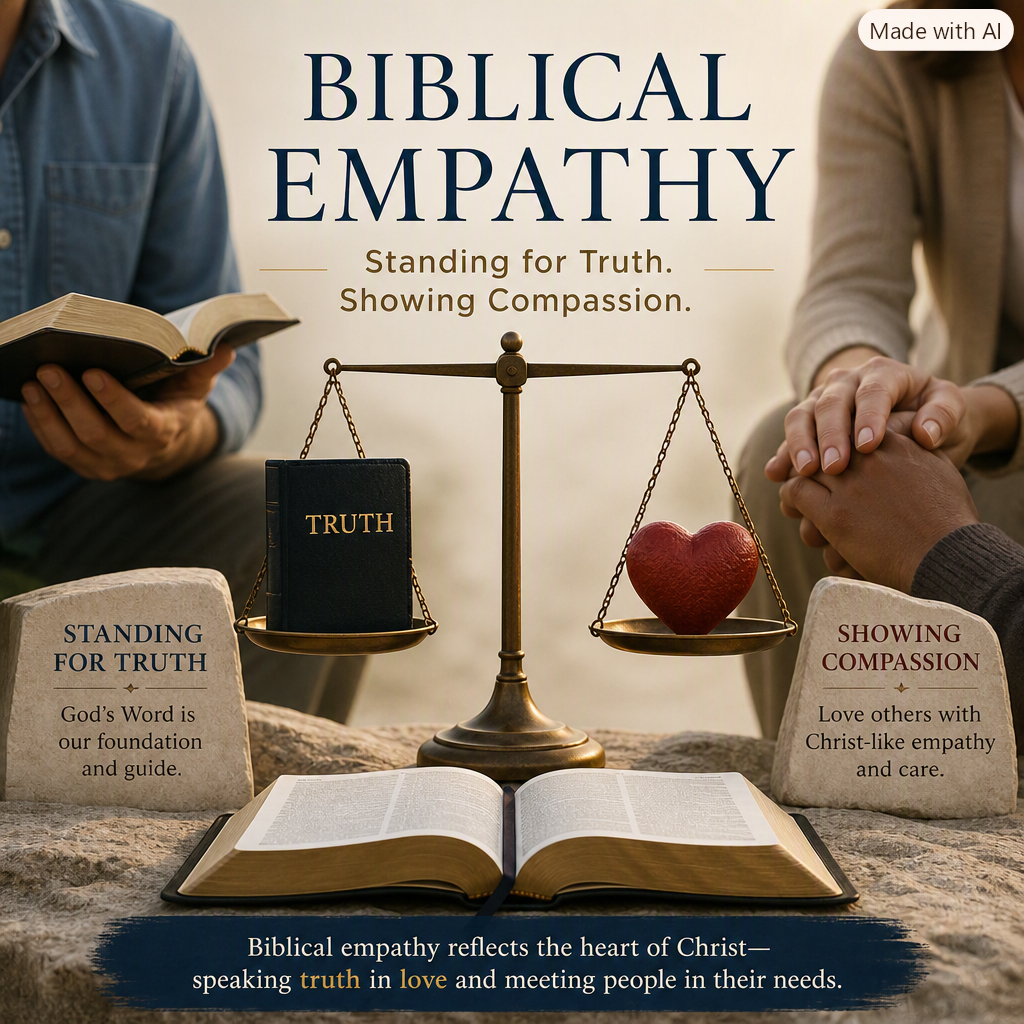
Biblical empathy is the ability to place oneself in another person’s situation and to feel compassion for that person. However, biblical empathy does not express agreement with differing theological viewpoints and does not condone unbiblical practices. Biblical empathizers understand the balance that is needed between being salt and light, standing for truth and exemplifying love (Matt. 5:13–16). Thus, the following argument can be constructed.
- If something teaches the importance of empathy and truth together, then it teaches biblical empathy.
- The Bible teaches the importance of empathy.
- The Bible teaches the importance of truth.
- Therefore, the Bible teaches biblical empathy.
A Case for Empathy in Biblical Empathy
Inasmuch as the first premise lays out the fundamental definition used for biblical empathy, it must be shown that the Bible teaches both the importance of empathy and truth. While a full treatment of this issue is not possible without flowing over into a mini book, we will offer an assessment of both premises, offering at least three passages defending both claims. The second premise will be defended in the next section.
What evidence do we have of empathy in the Bible? Granted, at times the newer concept of empathy is associated with sympathy in some contexts of Scripture. Nonetheless, the concept is still present.
Romans 12:15–18
The apostle Paul teaches about the importance of empathy in several passages. The apostle tells the Romans to “rejoice with those who rejoice; weep with those who weep. Live in harmony with one another. Do not be proud; instead, associate with the humble. Do not be wise in your own estimation. Do not repay anyone evil for evil. Give careful thought to do what is honorable in everyone’s eyes. If possible, as far as it depends on you, live at peace with everyone” (Rom. 12:15–18, Christian Standard Bible). In the opening moments of this text, Paul calls for a believer to have empathy. Now, one could say that Paul is only talking about Christians living among other Christians. But that is simply not the case. Paul encourages Roman Christians to live at peace with all people, believer and unbeliever alike. Certainly, associating with the humble would include unbelievers as well as believers. Romans 12 offers a strong case for a believer to show empathy to others.
Galatians 6:2
Among fellow believers, empathy should remain strong. In one of the earliest Pauline epistles, Paul instructs believers to “bear one another’s burdens, and so fulfill the law of Christ” (Gal. 6:2, English Standard Version). Part of bearing another person’s burdens is to show empathy, which will move one to compassion, which is understood as love in action.
1 Peter 3:8
Peter also exhorts believers to show empathy to others. Peter uses sympathy in a sense that can also be understood as empathetic. Peter argues that believers should “have unity of mind, sympathy, brotherly love, a tender heart, and a humble mind” (1 Pet. 3:8, ESV). The terms “sympathy” (συμπαθεἶς) and “tender heart” (εὐσπλαγχος) both speak of empathy. The term ὁμόφων, or “harmonious,” is of special interest. The term is described as “pertaining to being of the same mind or having the same thoughts as someone else.”[3] Now, this concept should not be taken to the extreme, since truth is also an important component as we shall soon see.
Luke 10:30–37
Finally, Jesus himself offers a strong case for biblical empathy in many of his teachings. The Parable of the Good Samaritan in Luke 10:30–37. In the story, a Samaritan showed compassion for a victim of robbery who was left for dead. Because of his empathy, he was moved to action. Jesus stated that the Samaritan “had compassion” (Lk. 10:33, ESV). Jesus uses the term ἐσπλαγχνίσθη that means to “experience great affection and compassion for someone,”[4] which highly involves an emotional capacity to feel the pain of another. Jesus personally exemplified empathy for others.
Matthew 9:36
Matthew’s Gospel noted that when Jesus saw the crowds, he “felt compassion for them, because they were distressed and dejected, like sheep without a shepherd” (Matt. 9:36, CSB). The deeper you dive into Scripture, the more reasons you find to be empathetic toward others.
A Case for Truth in Biblical Empathy
One of the major distinctions between biblical empathy and worldly empathy is that in biblical empathy a person does not bend truth and their convictions. In some modern iterations of empathy, everything about the person is accepted. In Scripture, one is reminded that love requires helping a person find peace with God. Truth does not change, and righteous standards do not change either.
Truth is Part of God’s Nature
God is before all things. As such, God holds all things together. The only limitations God has is God’s own ontological attributes. If God is holy (Lev. 11:44–45) and good (Ps. 34:8), then God cannot be evil and unholy. Likewise, if God is truth, then God cannot lie. That is exactly what the Scriptures tell us. The writer of Hebrews states that “it is impossible for God to lie” (Heb. 6:18, ESV). Likewise, God “cannot deny himself” (2 Tim. 2:13, ESV), therefore, God remains faithful (2 Tim. 2:13). Logic and truth are part of God’s nature. It is not that God created logic. Rather, logic flows out of a God who is truth. Thus, anything that is not truth is not of God, as falsehoods deny some component of God and God’s creation. Thus, if empathy is to be legitimate, then it must be grounded in truth. As the late Norman Geisler once stated, “Good reason does not subject God to finite minds but rather subjects our finite minds to His infinite Mind.”[5]
Truth is Foundational to Ethics
Additionally, when we think of ethics, we must assuredly think of the Ten Commandments. Yet, the Ten Commandments, the bastion of modern ethical principles, are based on truth. For instance, the ninth commandment is built on the correspondence theory of truth, stating, “You shall not bear false witness against your neighbor” (Exod. 20:16, ESV). Why is it ethical to tell the truth? Because telling the truth is based in love and in God’s nature. Even the first commandments that deal with Israel’s relationship with God are grounded in the truthful reality of God’s existence and the covenant that God made with the Hebrew people.
Truth is Loving
Speaking the truth, when done so appropriately, is loving since it seeks the best for others. Paul notes that a person should “speak the truth in love, we are to grow up in every way into him who is the head, into Christ” (Eph. 4:15, ESV). Correction is meant to help a person find their way and lead them in a better path. James observes that “if anyone among you wanders from the truth and someone brings him back, let him know that whoever brings back a sinner from his wandering will save his soul from deal and will cover a multitude of sins” (Jms. 5:19–20, ESV). Even the apologetic defense of the faith is built in love for the spiritual needs of others, seeking to “make a defense to anyone who asks you for a reason for the hope that is in you; yet do it with gentleness and respect” (1 Pet. 3:15, ESV).
Conclusion
As we have seen, empathy is a Christian virtue. It is not sinful, suicidal, or vile. Rather, empathy is absolutely essential if you are going to minister to the needs of others. Yet, it must be noted that empathy does not mean that you overlook problems, avoid challenges, change criteria, or weaken laws that are foundational for the security of us all. Biblical empathy seeks to understand the position and needs of others without losing personal convictions, epistemological truth claims, and the ontological basis of reality. Instead, biblical empathy strikes an appropriate balance between light and salt, love and truth. May we all seek to serve as examples of biblical empathy.
About the Author
Brian G. Chilton, M.Div., Ph.D.

Dr. Brian G. Chilton (PhD, Liberty University) is the founder of Bellator Christi Ministries and the co-host of the Bellator Christi Podcast. He serves as a hospice chaplain and an Adjunct Professor of Apologetics for Carolina College of Biblical Studies, a Dissertation Mentor/Adjunct Professor for Liberty University in the PhD in Applied Apologetics program, and an Adjunct Professor/Dissertation Reader at Carolina University in the DMin program. Dr. Chilton's primary area of research is on early Christianity, oral traditions, NT creeds, the blend of divine sovereignty and human freedom, and near-death experiences (NDEs).
Notes
[1] D. H. Stevenson, “Empathy,” in Baker Encyclopedia of Psychology & Counseling, ed. David G. Benner and Peter C. Hill, Baker Reference Library (Grand Rapids, MI: Baker Books, 1999), 397.
[2] Stevenson, “Empathy,” BEPC, 397.
[3] Louw-Nida, 30.21.
[4] Louw-Nida, 25.49.
[5] Norman L. Geisler, Systematic Theology, Volume One: Introduction, Bible (Minneapolis, MN: Bethany, 2002), 91.