
By: Dr. Amy Downey | September 27, 2026
Some might argue that I am exaggerating when I say that Leviticus 23 is a "Calendar of World History." I affirm this view, and this brief introduction will explain why Leviticus 23 begins with these words:
"And the LORD spoke unto Moses, saying, Speak unto the children of Israel, and say unto them, Concerning the feasts of the LORD, which ye shall proclaim to be holy convocations, even these are my feasts."
The word for "my feasts" is the Hebrew word (מוֹעֲדָֽי). However, the usual word for feast(s) that one hears is Chag, which simply means "feast." So ... why did God have Moses write the word (מוֹעֲדָֽי)? Perhaps these "holy convocations" have a more significant meaning, belonging solely to God.
The word (מוֹעֲדָֽי) means "an appointed time" or "appointment" or "season." And while Chag is used throughout Leviticus 23, the chapter begins with a time/season/appointment.
One can interpret this wording choice to mean a schedule for the year (which is another topic for Rosh Hashanah/Feast of Trumpets). However, could this be a schedule for more than just a year, but also literally for "all time"? I believe so, and let me explain why here, before we consider Rosh Hashanah below.
Jesus' first coming reached its ultimate moment at the spring feasts of the Feast of Passover (Crucifixion), Feast of Unleavened Bread (when he brought "captivity captive"), and the Feast of First Fruits (Resurrection).
The Holy Spirit came at Shavuot, which in Christian churches is called Pentecost. It is the only "summer feast" on the calendar.
And while I would never (EVER) set a date for Jesus' return, and as you will see, the Fall Feasts of Rosh Hashanah, Yom Kippur, and Sukkot fit easily into the biblical idea of Jesus' second coming.
Rosh Hashanah (Feast of Trumpets)
Leviticus 23:23-25 -- Then the Lord spoke to Moses, saying, “Speak to the children of Israel, saying: ‘In the seventh month, on the first day of the month, you shall have a sabbath-rest, a memorial of blowing of trumpets, a holy convocation. You shall do no customary work on it; and you shall offer an offering made by fire to the Lord.’”
These are the Biblical commands regarding the Feast of Trumpets (now known as Rosh Hashanah). Other passages expand on the commands, but these are the commands given by God and handed down to the people through Moses.
So ... let's look at these commands individually and corporately:
Sabbath Rest
Memorial of Blowing Trumpets
Holy Convocation
No Customary Work
Offering Made by Fire to the Lord (i.e., Sacrifice)
Sabbath Rest & No Customary Work...
Four primary Biblical passages underscore the importance and need for Sabbath rest in the Hebrew Scriptures—Exodus 20:8-11; Deuteronomy 5:12-14; Ezekiel 20:19-20; and Isaiah 58:13-14. Hebrews 4:9-10 provides another explanation of the value of the Sabbath Rest, and we find Jesus (Son of Man) as the "Lord of the Sabbath" in Matthew 12:8; Mark 2:28; and Luke 6:5.
Let us take a deeper look at what Isaiah 58:13-14 has to tell us about the need for rest:
IF you turn away your foot from the Sabbath, From doing your pleasure on My holy day, And call the Sabbath a delight, The holy day of the Lord honorable, And shall honor Him, not doing your own ways, Nor finding your own pleasure, Nor speaking your own words, THEN you shall delight yourself in the Lord; And I will cause you to ride on the high hills of the earth, And feed you with the heritage of Jacob your father. The mouth of the Lord has spoken.
The point of the Sabbath, according to Isaiah, is to honor God and to delight in him. If someone does so, then God will bless the individual(s). The section on the Sabbath goes into more specific details about the day of rest. However, this key passage explains that our responsibility is to honor God and not ourselves.
Holy Convocation -- Sacred Assembly (Leviticus 23:24)
The idea or concept of a holy convocation or assembly, in some translations, is mentioned here as it relates to the Feast of Trumpets/Rosh Hashanah. But what is the idea of a holy convocation or assembly in Biblical Hebrew?
An etymological (root-word) study of מִקְרָא suggests that this could be a rehearsal and/or a called-out assembly. Something or perhaps someone is being called out when the trumpets sound. The idea of the Feast of Trumpets as a rehearsal opens a plethora of possibilities that we will discuss soon.
Offering Made by Fire to the Lord (i.e., sacrifice)
Today, the Jewish people are confronted with the reality that there is no location upon which an acceptable sacrifice to God can be offered. In Leviticus, it was at the Tabernacle. From Solomon's time to the destruction of the Temple in 586 BC/BCE, it was at the so-called Temple of Solomon. During the Babylonian Exile, there was no Temple, so there was no sacrifice. After the Temple was rebuilt after the end of the exile and until the so-called Herod's Temple was destroyed in AD/CE 70, sacrifices resumed at the Temple. However, since AD 70, there has been no location or acceptable site to offer sacrifices. So ... what do or can the Jewish people do ... that would be acceptable to God?
Modern Yom Teruah (aka Rosh Hashanah) Practices
Today, Rabbinic Judaism has adjusted the facets of Yom Teruah from what the Torah requires into the holiday known as Rosh Hashanah (head of the year). This change occurred either around AD/CE 200, when rabbis altered the concept of sacrificial atonement, or, as some argue, during the Babylonian Captivity period, when the months were renamed to reflect more of Babylonian influence than Biblical concepts.
Regardless of when (I believe the final change happened in AD/CE 200), Yom Teruah changed. The only question is ... was this change for the better, or is changing something created by God even allowed? I believe the answer should be obvious ... NO. However, I want to share what one Modern Jewish website wrote about the issue:
Judaism has several different “new years,” a concept which may seem strange at first, but think of it this way: the American “new year” starts in January, but the new “school year” starts in September, and many businesses have “fiscal years” that start at various times of the year. In Judaism, Nissan 1 is the new year for the purpose of counting the reign of kings and months on the calendar, Elul 1 (in August) is the new year for the tithing of animals, Shevat 15 (in February) is the new year for trees (determining when first fruits can be eaten, etc.), and Tishri 1 (Rosh Hashanah) is the new year for years (when we increase the year number. Sabbatical and Jubilee years begin at this time). (https://jewishvirtuallibrary.org/rosh-hashanah-history-and-overview)
Now ... Read this paragraph several times and compare it against what Scripture teaches in Leviticus 23:5ff. There is only one first month in the Torah, known as Nissan (not the car), as the months were given names during the Babylonian Captivity. These extra "new years" are not from Scripture but from Modern Judaism.
Therefore, Yom Teruah became just one of the many "new years" in Judaism. The deep and true spiritual meaning of the day is lost and replaced with traditions which, while excellent, are not the best meaning of Yom Teruah.
-Celebrated with the eating of apples and honey & the casting (Tashlich) off of sins – throwing pieces of bread onto a lake/river.
-Reading Genesis 22 and considering the near sacrifice of Isaac by Abraham. However, and here also, the true meaning and foreshadowing message of Genesis 22 is not realized.
-It is also believed that God opens “The Books" and each individual's sins from the previous year are revealed. Then ... God begins to evaluate whether an individual should be designated "safe" for the coming year. Part of being found as worthy by God is the work of the individual to make right the wrongs they committed in the previous year. Is any of #3 Biblical or logical?
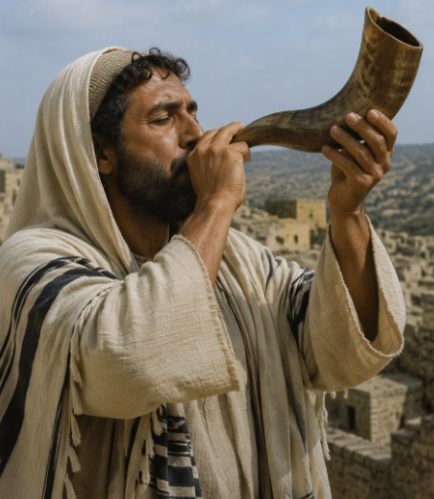
-Sounding of the Shofar to welcome in the "New Year." This action requires a series of blasts:
*Tekiah (king’s coronation)
*Shevarim (repentance)
*Teruah (to awaken the soul)
*Tekiah haGadol (Great Sabbath)
It is a powerful sound to listen to the shofar being blown. And ... there is a great deal of meaning to the sounding of the shofar, but today the Jewish people miss the truth that is found in 1 Thessalonians 4:16-17 --
"For the Lord himself shall descend from heaven with a shout, with the voice of the archangel, and with the SHOFAR of God: and the dead in Christ shall rise first: Then we which are alive and remain shall be caught up together with them in the clouds, to meet the Lord in the air: and so shall we ever be with the Lord."
This is the shofar (trumpet) blast that connects Yom Teruah to not only modern-day reality but also Biblical truth. Jesus will return with the blasting of a shofar, and everything will begin anew!
About the Author
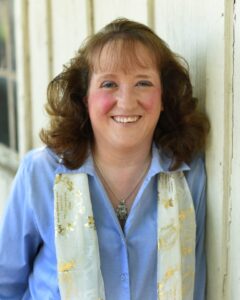
Dr. Amy Downey serves as the President and Director of Tzedakah Ministries, a ministry devoted to sharing the Gospel of Yeshua with Jewish people (http://tzedakahministries.org). Originally from Lubbock, Texas, Amy surrendered her life to full-time Christian service at the age of 16, but still struggled with her call to missions. Afraid of the price she might have to pay, Amy decided to serve God but in her own way. However, and finally, at the age of twenty-eight, Amy followed the mission call to reach the Jewish people with the truth that Jesus (Yeshua) is the Jewish Messiah.
This mission call has taken her across the country to speak in churches and meetings across more than thirty states and four continents (8 countries) about the need for the Christian church to take on the responsibility of Jewish evangelism mandated in Romans 1:16 and 11:11-24. Amy has shared the truth of Jesus to Jewish people on street corners, airplanes, parks, restaurants, and even in churches. In addition, she spent three of the most spiritually challenging and rewarding years of her life in the heart of American Jewish life – New York City.
Amy has a Bachelor of Science in Education degree from East Texas Baptist University and a Master of Arts in Communication and Master of Arts in Theology from Southwestern Baptist Theological Seminary and was the first woman to complete a Ph.D. in Theology and Apologetics from Liberty University (May 2016). She is also the author of Paul’s Conundrum (2011), Maimonides’s Yahweh (2019), and Missions in the Minor Key (2024), along with numerous magazine articles and booklets that are available at https://tzedakahministries.org. Amy serves as a contributor and Associate Vice President for Bellator Christi Ministries.