
By: Brian G. Chilton, PhD | August 30, 2026
In recent weeks, and even recent years, deconstruction movements have caused multiple individuals to reexamine their faith. While conservative evangelicals have often opposed such practices, deconstruction has unknowingly entered the sphere of even evangelical apologetics. Some podcasters, theologians, and apologists have wrestled with major Christological[1] ideas regarding the eternal nature of Christ. Though the topic of Christ’s eternal nature is extremely important, the greater issue is what constitutes the boundaries of orthodoxy. This article will evaluate the boundaries of orthodoxy. But first, consider the modern need to return to an ancient formulation.
Problems with Celebrity Culture and the Need for Authority
Let’s face it. Celebrity culture is dangerous. Mainly, the danger arises from the failure of individuals to evaluate the arguments made by their favorite speaker or thinker. Instead, a form of tribalism develops where a person blindly adopts whatever their chosen speaker or thinker advocates.
A couple of problems emerge from this practice. First, it goes against the biblical command to evaluate a claim’s fidelity to orthodoxy. The apostle John said, “Do not believe every spirit, but test the spirits to see whether they are from God, for many false prophets have gone out into the world. By this you know the Spirit of God: every spirit that confesses that Jesus Christ has come in the flesh is from God, and every spirit that does not confess Jesus is not from God” (1 Jn. 4:1b–3b, English Standard Version). That is not to say that anyone who thinks through issues or presents alternative perspectives is necessarily the antichrist. But it does show that every message should be evaluated by a higher authority.
Second, the lack of intellectual and spiritual evaluation of claims could easily lead to cults. I am in my third year of teaching worldviews to college students. Almost always a cult arises from an aberration of classic orthodoxy—usually due to an alternative view of Christ—and the elevation of a celebrity teacher, often placed in the place of Christ. But the question then arises, what constitutes the basis of historic Christian orthodoxy?
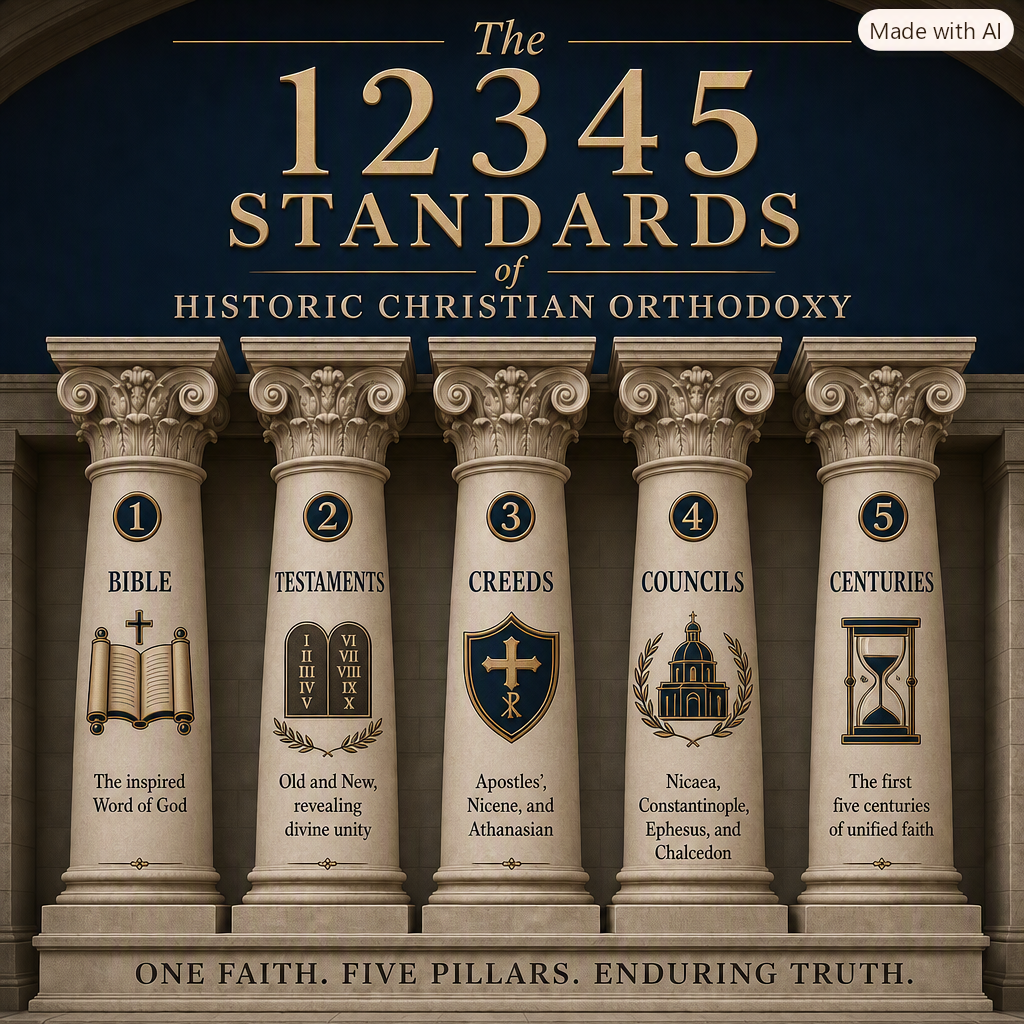
Geisler observes that “the root basis for historic orthodoxy is found in one Bible, two Testaments (Old and New), three creeds …, four councils …, and five centuries.”[2] The church was united in its acceptance of these beliefs. However, afterward, “there was little unity, and progressive unorthodoxy”[3] until the later formulation of the Council of Trent (1545), where the church was told to abide by the authority of the Roman Catholic Church. Before the Protestant Reformation of 1517 (that split Protestants from the Roman Catholic Church) and the Great Schism of 1054 (that split the Eastern Orthodox Church from the Roman Catholic Church), the united church agreed on these fundamental doctrines. And that’s saying something! For the remainder of this article, consider the 12345 standards of historic Christian orthodoxy.
1 Bible
For the purposes of this article, a full exploration of the canonicity of Scripture is not feasible. Such a work would require several other articles. However, we can state that the adoption of the Bible as the Word of God is something held sacred to all Christ follower. The term “canon” describes a rule or norm that flows from a collection of books held to be inspired by God.[4] The apostle Paul notes that “All Scripture is breathed out by God and profitable for teaching, for reproof, for correction, and for training in righteousness” (2 Tim. 3:16).
These books were written by prophets, apostles, and scribes. As such, the apostle Peter acknowledges that the writings of these books are inspired by God. He said that “no prophecy of Scripture comes from someone’s own interpretation. For no prophecy was ever produced by the will of man, but men spoke from God as they were carried along by the Holy Spirit” (2 Pet. 1:20–21). The books contained within the Protestant Bible consist of those that hold universal agreement in Judaism, Catholicism, and Protestantism. As such, the Bible as led by the Holy Spirit should be the primary standard of orthodoxy.
2 Testaments
The biblical canon consists of both the Old and New Testaments. The Old Testament prophesied the arrival of Christ and the redemption that would come through him. The Old Testament sets the stage by showing the creation of the world and the attributes of the Creator. The Psalms, Job, and the prophets all hold tremendous theological principles about the divine attributes of God. The book of Genesis also explains how humanity fell from God’s grace, as evidenced through the increasingly depraved nature of humanity without God.
The New Testament describes the person and work of Christ and the Holy Spirit. It connects Christ’s life back to the Old Testament, showing how Christ is the redemption of humanity and the glorious restoration that would come through his work. Both Testaments are necessary to show God’s big picture for humanity and the history of the world. As such, the complete Bible found within both Testaments are the source for Christian orthodoxy. Additionally, the biblical canon is now closed, meaning that no other books are needed or inspired. The story has been told and is being played out in history.
3 Creeds
Before the major splits of the church (Great Schism of 1054 and the Protestant Reformation of 1517), the universal church agreed on three major creeds. These creeds post the boundaries of faith. Believers outside these boundaries can be considered heterodox if not downright heretical.
1. Apostles Creed
This is the earliest creed established by the church, outside of those found in Scripture. The Apostles Creed is believed to have been developed by the second generation of the church and was a summary of the apostles’ teaching. It goes as follows:
“I believe in God the Father almighty, creator of heaven and earth;
And in Jesus Christ, His only Son, our Lord,
Who was conceived by the Holy Spirit, born from the Virgin Mary,
suffered under Pontius Pilate, was crucified, dead and buried, descended into hell,
on the third day rose again from the dead,
ascended to heaven, sits at the right hand of God the Father almighty,
thence He will come to judge the living and the dead;
I believe in the Holy Spirit,
the holy Catholic Church,
the communion of saints,
the remission of sins,
the resurrection of the flesh,
and eternal life.
Amen.”[5]
2. Nicaean Creed (325)
The Nicaean Creed came out of both the Council of Nicea and the Council of Constantinople of 381. This creed expands some of the beliefs of the Apostles Creed. Because it combines two councils, it is often called the Niceno-Constaninopolitan Creed.
“We believe in one God, the Father Almighty, maker of heaven and earth, and of all things visible and invisible;
And in one Lord Jesus Christ, the only-begotten Son of God, begotten of the Father before all ages, light from light, true God from true God, begotten not made, of one substance [homoousios] with the Father, through whom all things were made; who for us human beings and for our salvation came down from heaven and was incarnate of the Holy Spirit and the Virgin Mary and became human, and was crucified for us under Pontius Pilate, and suffered and was buried, and rose again on the third day according to the Scriptures, and ascended into heaven, and sits on the right hand of the Father, and will come again with glory to judge the living and the dead, of whose kingdom there shall be no end;
And in the Holy Spirit, the Lord and the life-giver, who proceeds from the Father, who with the Father and the Son is together worshiped and together glorified, who spoke through the prophets;
In one holy, catholic, and apostolic church. We confess one baptism for the confession of sins; we look forward to the resurrection of the dead and the life of the world to come. Amen.”[6]
3. Athanasian Creed (542)
This creed is a much longer summary of the previous creeds. Of the three creeds, the Athanasian Creed holds much more flexibility. However, its principles flow from the Apostles and Nicaean Creeds. It goes as follows:
“Whoever wants to be saved should above all cling to the catholic faith. Whoever does not guard it whole and inviolate will doubtless perish eternally. Now this is the catholic faith:
We worship one God in trinity and the Trinity in unity, neither confusing the persons nor dividing the divine being. For the Father is one person, the Son is another, and the Spirit is still another. But the deity of the Father, Son, and Holy Spirit is one, equal in glory, coeternal in majesty. What the Father is, the Son is, and so is the Holy Spirit. Uncreated is the Father; uncreated is the Son; uncreated is the Spirit. The Father is infinite; the Son is infinite; the Holy Spirit is infinite. Eternal is the Father; eternal is the Son; eternal is the Spirit: And yet there are not three eternal beings, but one who is eternal; as there are not three uncreated and unlimited beings, but one who is uncreated and unlimited. Almighty is the Father; almighty is the Son; almighty is the Spirit: And yet there are not three almighty beings, but one who is almighty. Thus the Father is God; the Son is God; the Holy Spirit is God: And yet there are not three gods, but one God. Thus the Father is Lord; the Son is Lord; the Holy Spirit is Lord: And yet there are not three lords, but one Lord.
As Christian truth compels us to acknowledge each distinct person as God and Lord, so catholic religion forbids us to say that there are three gods or lords. The Father was neither made nor created nor begotten; the Son was neither made nor created, but was alone begotten of the Father; the Spirit was neither made nor created, but is proceeding from the Father and the Son. Thus there is one Father, not three fathers; one Son, not three sons; one Holy Spirit, not three spirits. And in this Trinity, no one is before or after, greater or less than the other; but all three persons are in themselves, coeternal and coequal; and so we must worship the Trinity in unity and the one God in three persons. Whoever wants to be saved should think thus about the Trinity. It is necessary for eternal salvation that one also faithfully believe that our Lord Jesus Christ became flesh.
For this is the true faith that we believe and confess: That our Lord Jesus Christ, God’s Son, is both God and man. He is God, begotten before all worlds from the being of the Father, and he is man, born in the world from the being of his mother—existing fully as God, and fully as man with a rational soul and a human body; equal to the Father in divinity, subordinate to the Father in humanity. Although he is God and man, he is not divided, but is one Christ. He is united because God has taken humanity into himself; he does not transform deity into humanity. He is completely one in the unity of his person, without confusing his natures. For as the rational soul and body are one person, so the one Christ is God and man.
He suffered death for our salvation. He descended into hell and rose again from the dead. He ascended into heaven and is seated at the right hand of the Father. He will come again to judge the living and the dead. At his coming all people shall rise bodily to give an account of their own deeds. Those who have done good will enter eternal life, those who have done evil will enter eternal fire. This is the catholic faith. One cannot be saved without believing this firmly and faithfully.”[7]
While this creed holds greater interpretive flexibility, the commitment to the oneness of Christ in both his divine and human natures is a necessary component of orthodoxy.
4 Councils
As previously noted, the decisions of the church in the first few centuries discovered and summarized the core components of the Christian faith. These councils established certain core Christian doctrines, which make them authoritative to all believers.
1. Nicaean Council (325)
The Council of Nicea of 325 defended Athanasius’s view of Christ and deemed Arius’s view heretical. Athanasius maintained that Christ was eternal, whereas Arius believed that Christ was not eternal but was created or begotten of God. The council was important to steer the church toward an orthodox view of Christ as depicted in Scripture.
2. First Constantinople (381)
The First Constantinople Creed of 381 further accepted and fleshed out the decisions made in Nicea. They also affirmed the divine nature of the Holy Spirit. The council rejected the opinions of the Macedonians, who accepted Christ’s deity but rejected the Spirit’s divinity.
3. Council of Ephesus (431)
The Council of Ephesus settled a theological dispute between Cyril of Alexandria and Nestorius. Cyril held that Christ was united in his divine and human natures, whereas Nestorius held that the Logos and a human person were united in action but not in personhood. The Council agreed with Cyril and deemed Nestorianism a heresy.
4. Council of Chalcedon (451)
This council affirmed that Christ possessed two natures—fully God and fully human—in one person. Additionally, it also solidified the classical Trinitarian viewpoint held by the church to this day.
5 Centuries (First Century–600 AD)
The last point of this five-step plan is the easiest. The creeds and councils already mentioned occurred within the first five centuries of church history. After the first five centuries, councils became more segmentalized and dealt with denominational issues, which would later devolve into schisms and controversies. However, the creeds and councils of the first five centuries directed orthodoxy for all Bible-believing Christians.
Conclusion
This article has been quite lengthy due to the quotations needed for the creeds. Nonetheless, the 12345 standards of historic Christian orthodoxy serve as a good basis for evaluating whether a teaching is orthodox, heterodox, or even heretical. Commitment to orthodoxy matters. Blindly following a leader bound to non-Christian teachings leads down bad paths. Watch any documentary on cults and cultic churches, and you will quickly see why. I conclude with a message given to the church by the apostle Paul, which should serve as a charge to every Bible-believing Christian. Paul states, “But even if we or an angel from heaven should preach to you a gospel contrary to the one we preached to you, let him be accursed. As we have said before, so now I say again: If anyone is preaching to you a gospel contrary to the one you received, let him be accursed” (Gal. 1:8–9). Now, this is not addressed nor implied of any modern teacher or movement. But it does serve as an admonition to evaluate theological claims carefully.
About the Author
Brian G. Chilton, PhD

Dr. Brian G. Chilton (PhD, Liberty University) is the founder of Bellator Christi Ministries and the co-host of the Bellator Christi Podcast. He serves as a hospice chaplain and an Adjunct Professor of Apologetics for Carolina College of Biblical Studies, a Dissertation Mentor/Adjunct Professor for Liberty University in the PhD in Applied Apologetics program, and an Adjunct Professor/Dissertation Reader at Carolina University in the DMin program. Dr. Chilton's primary area of research is on early Christianity, oral traditions, NT creeds, the blend of divine sovereignty and human freedom, and near-death experiences (NDEs)
[1] Christology is the study of Christ.
[2] Norman Geisler, Systematic Theology, Volume Four: Church, Last Things (Minneapolis, MN: Bethany, 2005), 101.
[3] Geisler, Systematic Theology, Volume Four, 101.
[4] See Norman Geisler, Systematic Theology, Volume One: Introduction, Bible (Minneapolis, MN: Bethany, 2002), 514.
[5] Elliot Ritzema and John D. Barry,, “Apostles Creed,” in The Lexham Bible Dictionary, ed. John D. Barry et al. (Bellingham, WA: Lexham Press, 2016), ng.
[6] Ivor J. Davidson, A Public Faith: From Constantine to the Medieval World, A.D. 312–600, ed. Tim Dowley, The Monarch History of the Church (Oxford, UK; Grand Rapids, MI: Monarch Books, 2005), 97.
[7] Got Questions Ministries, Got Questions? Bible Questions Answered (Bellingham, WA: Logos Bible Software, 2002–2013).