
By: Sherene Khouri, Th.M., Ph.D. | July 12, 2026
The Kingdom of God: More Than a Place
The expression “the Kingdom of God” appears throughout Scripture and occupies a central place in biblical theology. An important question arises: Does this expression carry the same meaning throughout Scripture, or does it take on different nuances depending on its context? This paper examines the concept of the Kingdom of God, highlighting the richness and complexity of its theological significance. In doing so, it hopes to guide Christians toward a more accurate and biblically informed understanding of how this expression should be interpreted and applied.
The Kingdom of God: A Linguistic Meaning
The idea of the “kingdom” can be puzzling, especially considering how this term is used today. When this word is mentioned, some might think of medieval knights, European or Arabian kingdoms, or castles that were at one point inhabited by monarchs. The basic meaning should include a king and subjects. Today, Christians hold differing views regarding the nature of the kingdom of God. Some emphasize God’s sovereignty and understand the kingdom as primarily a spiritual reality associated with the new heaven and new earth. Others maintain that the kingdom of God has already been inaugurated and is present among believers today, while still others argue for a solely future physical manifestation of the kingdom on earth during the millennium. In light of these differing perspectives, an important question arises: Does the expression “the kingdom of God” mean the same thing every time it is mentioned in the Bible?
The Kingdom of God in the Old Testament
It is a statement about God being the king and his people under his rule and reign. For example, Psalm 47:2 asserts that God bears the title “king.” God reigns as king (Ps. 93:1; 96:10 ESV), He rules (Judg. 8:23; Ps. 22:28), He sits on a throne (1 Kgs. 22:19; Ps. 103:19; Eze. 1:26–28), and He maintains a kingdom (Ps. 45:6; 2 Kgs. 19:15).[1]
Some scholars suggest that three aspects emerge in the OT from this expression: the universal aspect of the kingdom, the theocratic (or mediatorial) aspect, and the eternal aspect. According to Woods, “The universal kingdom is eternal, comprehensive, under God’s direct rule, and always in existence. By contrast, the theocratic kingdom is futuristic, earthly, under God’s indirect rule, and conditional.”[2] In Psalm 93:1-2, the kingdom is presented as eternally existing, while Daniel 2:44 indicates that the kingdom will be a future reality. Moreover, Psalm 103:19 depicts the kingdom as universal in scope, while Daniel 2:35, 44-45 portrays it as earthly. In addition, Daniel 4:17 presents the kingdom as being directly ruled by God, whereas Psalm 2:6-9 describes the kingdom as being indirectly administered by God through a human agent. Taken together, these passages demonstrate that the Old Testament presents the kingdom of God as a multifaceted reality—simultaneously universal, theocratic, and eternal.
The Kingdom of God in the New Testament
The kingdom of God is a major feature in the ministry of Jesus. Jesus does not define what the kingdom of God is directly, but describes it via parables.[3] The discourse about who will (or will not) enter the kingdom is a description of it as a place where God’s sovereign rule is exercised over all dimensions of personal and social life (Matt 7:21; 19:23; Mark 10: 25; Luke 18:25; John 3:5). Furthermore, when Jesus talked about his kingdom as not being of this world (John 18:36),[4] he did not mean that his rule has no place or is irrelevant to the world; rather, he emphasized that his kingship and authority originate from God, not from human institutions.[5]
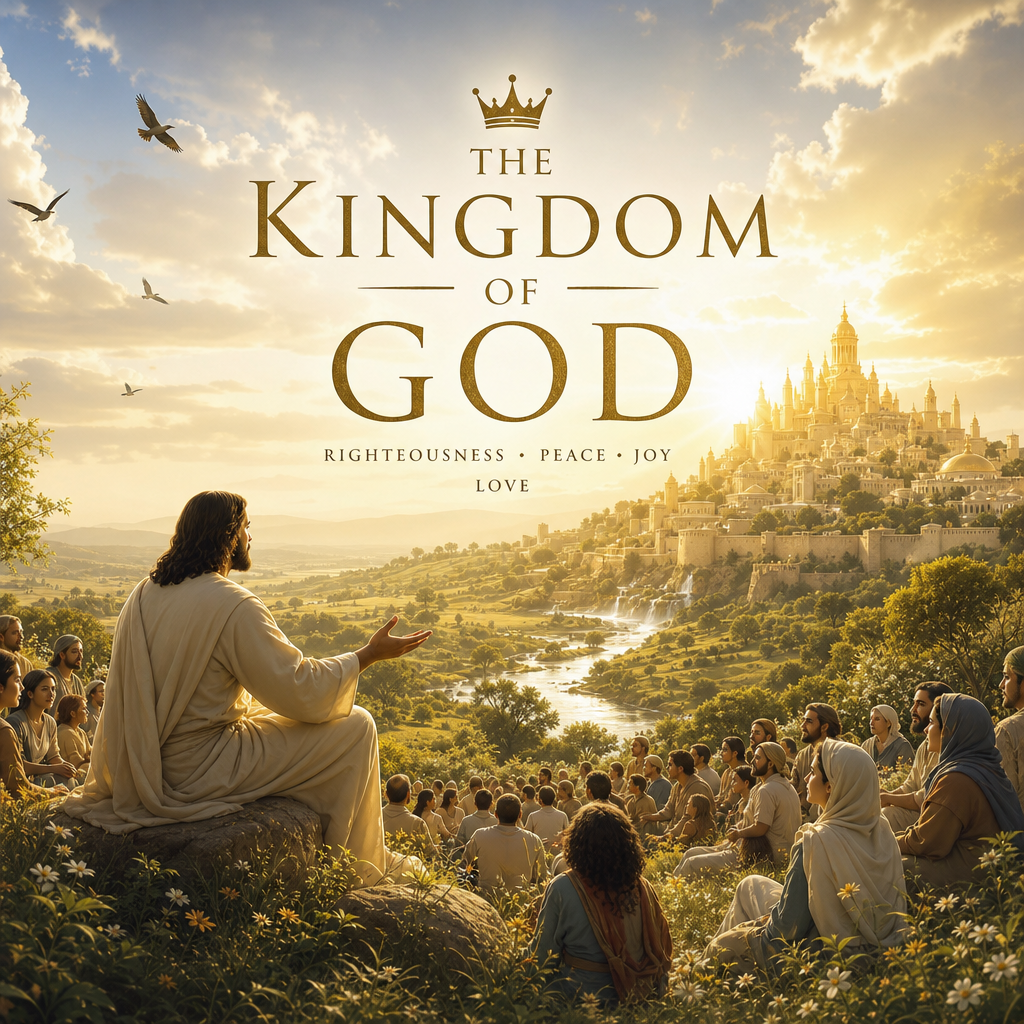
Although Jesus described the kingdom of God as a place, he emphasized that it does not arrive in ways that are visible or perceptible. In Romans 14: 17, Paul states that “the kingdom of God is not a matter of eating and drinking but of righteousness and peace and joy in the Holy Spirit.” Similarly, in 1 Corinthians 4:20, he states, “the kingdom of God does not consist in talk but in power.”
The kingdom of God is not merely a place; it is also good news about Jesus and the redemption of the church. In Matthew 24:14, Jesus states, “And this gospel of the kingdom will be proclaimed throughout the whole world as a testimony to all nations, and then the end will come.” This gospel of the kingdom is a message that must be proclaimed to the world before the end, emphasizing that it is not simply a future dwelling place for believers but good news to the world.[6] The book of Acts reinforces this idea. For example, Philip went to Samaria to preach the gospel of the kingdom there. “But when they believed Philip as he preached good news about the kingdom of God and the name of Jesus Christ, they were baptized, both men and women” (Acts 8:12). In the same way, from his house arrest, Paul proclaimed to the Jewish leaders in Rome the good news of God’s kingdom concerning Jesus (Acts 28:23). Thus, the kingdom of God is not just a future reality in its fullness, but the message of Christ’s redemptive work pointing toward its future consummation.
Conclusion
In conclusion, the biblical witness consistently presents the kingdom of God as the reality of God’s sovereign rule exercised over his creation and his people. In the Old Testament, this kingship is affirmed through explicit declarations of God’s reign, his throne, and his universal authority, while also unfolding in multifaceted ways: universal, theocratic, and eternal. The New Testament builds upon this foundation by centering the kingdom in the person and mission of Jesus Christ, who embodies and inaugurates God’s reign. Through his teaching, ministry, death, and resurrection, Jesus reveals that the kingdom is a future hope awaiting its citizens. Thus, the kingdom of God is not merely a place or a distant promise, but the dynamic expression of God’s rule, proclaimed as good news and realized in Christ, calling all people to live under his gracious authority.
About the Author
Sherene Khouri, Th.M., Ph.D.
Sherene Khouri was born into a religiously diverse family in Damascus, Syria. She became a believer when she was 11 years old. Sherene and her husband were missionaries in Saudi Arabia. Their house was open for meetings, and they were involved with the locals until the government knew about their ministry and gave them three days’ notice to leave the country. In 2006, they went back to Syria and started serving the Lord with RZIM International ministry. They traveled around the Middle Eastern region—Turkey, Jordan, Egypt, Lebanon, Syria, and the United Arab Emirates.
Sherene was also involved in her local church among the young, young adults, and women's ministry. In 2013, the civil war broke out in Syria. Sherene and her husband’s car was vandalized 3 times, and they had to immigrate to the United States of America. In 2019, Sherene became an American citizen.
Sherene is an Assistant Professor at Liberty University. She teaches Arabic, Religion, and Research classes. Additionally, she holds a Ph.D. in Theology and Apologetics, M.A. in Christian Apologetics from Liberty University, and B.S. in Biblical Studies from Moody Bible Institute. Currently, Sherene is also working on a Master of Theology in Global Studies at Liberty University and M.A. in Arabic and linguistics from PennWest University.
Bibliography
Ladd, George Eldon. The Gospel of the Kingdom: Scriptural Studies in the Kingdom of God. Grand Rapids: William B. Eerdmans Publishing, 1990.
Ladd, George E. “Kingdom of God (Heaven).” In Baker Encyclopedia of the Bible, 2:1269–78. Grand Rapids, MI: Baker Book House, 1988.
Martin, John A. “Luke.” In The Bible Knowledge Commentary: An Exposition of the Scriptures, Edited by J. F. Walvoord and R. B. Zuck. Wheaton, IL: Victor Books, 1985.
Schreiner, Thomas R. “Luke.” In Evangelical Commentary on the Bible, 3:824. Grand Rapids, MI: Baker Book House, 1995.
Seal, David. “Kingdom of God.” In The Lexham Bible Dictionary, edited by John D. Barry, David Bomar, et. al. Bellingham, WA: Lexham Press, 2016.
Notes
[1] The Lexham Bible Dictionary, (Bellingham, WA: Lexham Press, 2016), s.v. "Kingdom of God." Logos.
[2] Woods, The Coming Kingdom, 388.
[3] The Lexham Bible Dictionary, s.v. “Kingdom of God,” Logos.
[4] Some translations, such as KJV and ASV add the word “now” to the second part of the verse. “But now is my kingdom not from hence.”
[5] George E. Ladd, “Kingdom of God (Heaven),” in Baker Encyclopedia of the Bible, 2:1269–78, (Grand Rapids, MI: Baker Book House, 1988). Logos.
[6] George Eldon Ladd, The Gospel of the Kingdom: Scriptural Studies in the Kingdom of God (Grand Rapids: William B. Eerdmans Publishing, 1990, 109-110).