
By: Brian G. Chilton, PhD | September 13, 2026
Having Gary Habermas as one of my professors in a face-to-face class setting was one of the numerous blessings my colleagues and I had when taking the Ph.D. in Theology and Apologetics residential program. Habermas is more than just a professor. God used his work to greatly help me when I had been struggling with my faith. Habermas is a world-esteemed scholar on the resurrection.
One of his most important contributions to the academy was what he calls the minimal facts argument (MFA). To understand his argument, you must first understand the background behind his Ph.D. studies at Michigan State University. He was told that the only way he could defend the resurrection at Michigan State was if he only used information that the majority of scholars accepted. And from those delimitations, the MFA was born. More on that in a moment.
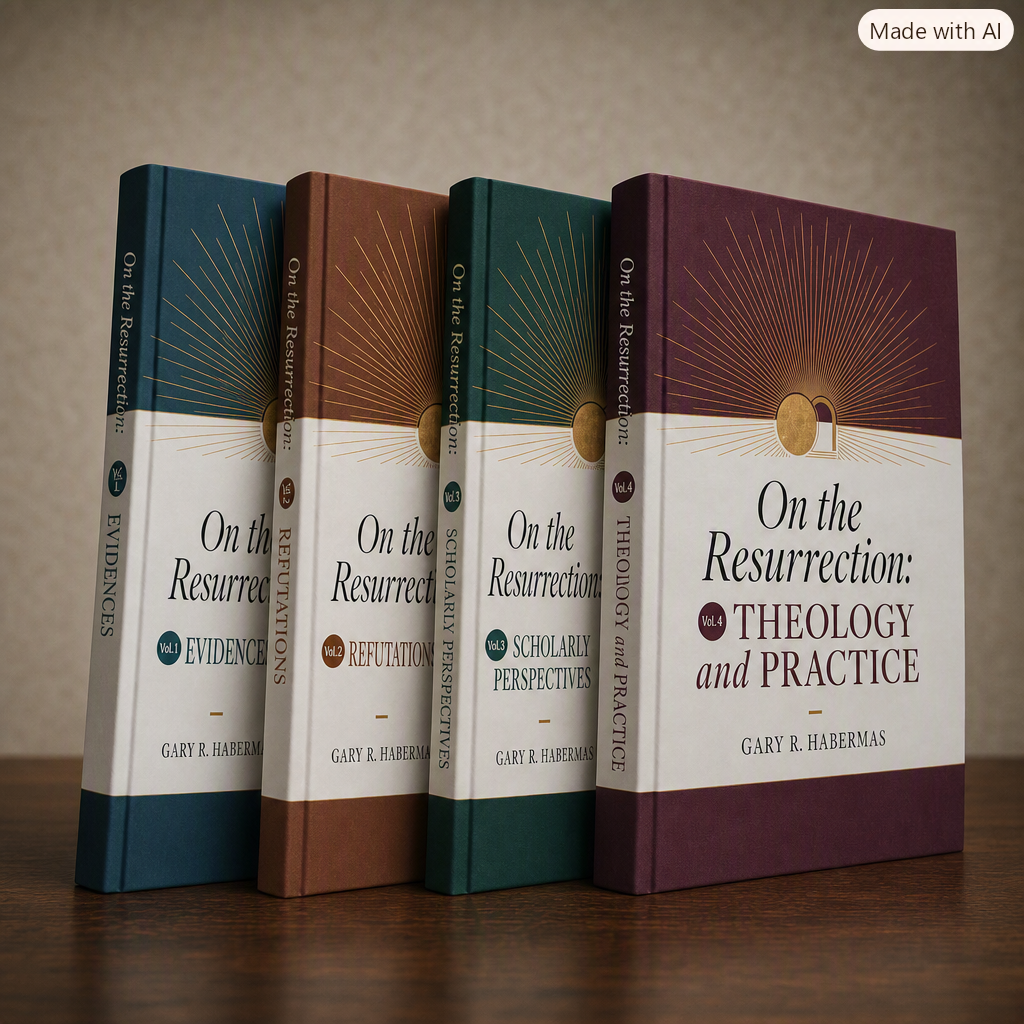
Habermas, now in his upper 70s, desired to write a series of books that contained all the research and information he had acquired over his illustrious academic career. Thus, he wrote what he calls his “magnum opus.” The official title of the series is called On the Resurrection.
The fourth and final volume of his magnum opus was released a few weeks ago. The work is now complete. Now that the series is complete, I would like to take a few moments to look through his series by offering an overview of the four-volume set. Then, I would like to rank my favorite books in the series by those that are most impactful and useful. Mind you, at the time of this writing, I have not completely finished Volumes 2 and 4. But I have reviewed the books enough to be able to offer a synopsis.
An Overview of the Four-Volume Set
As previously noted, On the Resurrection is a four-volume set. The work exclusively offers an apologetic defense for the resurrection of Jesus. But it does so in four different ways based on the four distinct volumes.
Volume 1: The Evidence. The first volume examines all the data defending the MFA. The MFA is based around 6+1 arguments—six are held by over 90% of scholars, whereas one is held by a substantial number of scholars, around 75%. The MFA includes the following components: 1) Jesus died by crucifixion; 2) the disciples had experiences that led them to believe that Jesus had risen from the dead; 3) the proclamation of the resurrection was early; 4) the disciples were transformed by their encounters with the risen Jesus; 5) James, the brother of Jesus, came to believe in Jesus after experiencing the risen Jesus; and 6) Paul, a former enemy of the Christian movement, came to believe in Jesus after his experience with the risen Jesus. The seventh component is that the tomb was found empty. Again, the seventh fact does not hold the level of consensus that the previous six do, but it is still strong. After establishing these data points, Evidences then explores each of these minimal facts and offers evidence for their historicity.
Volume 2: Refutations. The second volume explores the different skeptical challenges to the resurrection. Habermas heavily examines the work of David Hume before exploring the views of Barth, Bultmann, and others. The book shows the incoherency of the swoon theory, charges of fraud, and hallucinations. It also shows the inconsistencies of the claims that the resurrection was based on pagan mystery religions.
Volume 3: Scholarly Perspectives. Volume 3 reads much differently than the other three. Rather than a narrative, the book offers a series of quotes from various scholars, both conservative and liberal, on the topic of Christ’s resurrection. This book will not be for everyone. However, it is critical for someone who is engaged in scholarly research, especially at the graduate level. In fact, Volume 3 may be one of the most important books for those interested in researching the resurrection of Jesus.
Volume 4: Theology and Practice. The last volume was recently published and marks the end of the magnum opus. To be honest, the fourth volume is the most practical of the entire series and is one of my personal favorites. Theology & Practice shows the theological, philosophical, and practical applications of the resurrection. In this volume, Habermas connects the resurrection with the existence of God, miracles, and a theistic universe. Additionally, the fourth volume speaks to various forms of doubt and how they are overcome with the evidence. Finally, Habermas personally shows how the case for the resurrection helps a person when dealing with doubt.
Ranking the Best Volumes
The previous section offered an overview of the On the Resurrection series. Now, I would like to a list of my personal favorite volumes in this set.
Favorite: Evidences. The first and second entries on this list are tied for my favorite books in the series. However, the centerpiece of this work is still found in the first volume, Evidences. Because it serves as the cornerstone and foundation of the series, Evidences take the top spot. Therefore, if you can only commit to one book in this series and want a defense for the resurrection, look no further than Evidences.
Second: Theology & Practice. The last volume is honestly one of the most important books of the series as it pertains to the practical side of the resurrection. Honestly, I wanted to add this book as my favorite. However, you need Volume 1 before you catch the impact of Volume 4. Theology & Practice is the most impactful of the series, as it shows why the resurrection matters. Habermas’s treatment of doubt and the impact the resurrection makes when facing times of grief is world-class. His work on doubt has not received the attention it deserves. I love this volume so much that I would go on a limb to say that if you already have a working knowledge of Habermas’s defense of the resurrection and can only get one volume, purchase Volume 4. But if you don’t, start with Volume 1 and then get Volume 4. The bookends of the series are by far the best.
Third: Scholarly Perspectives. Volume 3 is a must-have for anyone interested in scholarly research. Since I am in scholarly research, this book was extremely beneficial for my work in apologetics. However, for the normal, everyday reader, they may not find this work as helpful. The book consists of a listing of quotes and resources used to examine the field of study on resurrection studies. While I found it very helpful, not everyone will.
Fourth: Refutations. Volume 2 was my least favorite, but that does not mean that it is unimportant. Refutations is a must-have to the series. However, it is polemical, meaning that it shows how opposing viewpoints are incoherent. Such a practice is incredibly important to the apologetic enterprise. But for me, I want the positive apologetic (reasons for believing in something) before the negative apologetic (reasons why something should be rejected). The second volume is really good. And if you are challenged by some of the skeptical challenges against the resurrection, then you might need to pick up this volume first. However, in my estimation, if you are on a budget, Volumes 1 and 4 offer such a punch that Volumes 2 and 3 may not be needed.
Conclusion
I highly recommend Habermas’s magnum opus. Sitting in Lynchburg and hearing Habermas speak of writing this series, I often wondered what the series would be like. Honestly, it did not disappoint. The series lives up to the hype and delivers on its promises. Readers are encouraged to purchase all four volumes, as each one is important. However, if you could only choose two to purchase, I would recommend the first and fourth.
Here is my recommended purchasing order:
1st: Evidences (volume 1)
2nd: Theology & Practice (volume 4)
3rd: Refutations (volume 2)
4th: Scholarly Perspectives (volume 3)
About the Author
Brian G. Chilton, PhD

Dr. Brian G. Chilton (PhD, Liberty University) is the founder of Bellator Christi Ministries and the co-host of the Bellator Christi Podcast. He serves as a hospice chaplain and an Adjunct Professor of Apologetics for Carolina College of Biblical Studies, a Dissertation Mentor/Adjunct Professor for Liberty University in the PhD in Humanities program, and an Adjunct Professor/Dissertation Reader at Carolina University in the DMin program. Dr. Chilton's primary area of research is on early Christianity, oral traditions, NT creeds, the blend of divine sovereignty and human freedom, and near-death experiences (NDEs).




Habermas never justifies leaping from "Jesus rose from the dead" over to "it applies in the 21st century". And it is a legitimate question since much in the OT doesn't apply to today, much in Matthew doesn't apply to today, and the more dispensationalist a Christian is, the more they will tell us Jesus' original gospel was legalistic, and doesn't apply to the church age. With so much precedent indicating many biblical things don't apply to the 21st century, it is perfectly legitimate to demand today's Christians to show, not merely assume, that something about Jesus' resurrection applies to 21st century unbelievers. So far, this appears to be an impossible task, especially for Sola Scriptura adherents who necessarily think the bible alone is entirely sufficient to support the answer.