
By: Daniel Sloan, PhD | May 17, 2026
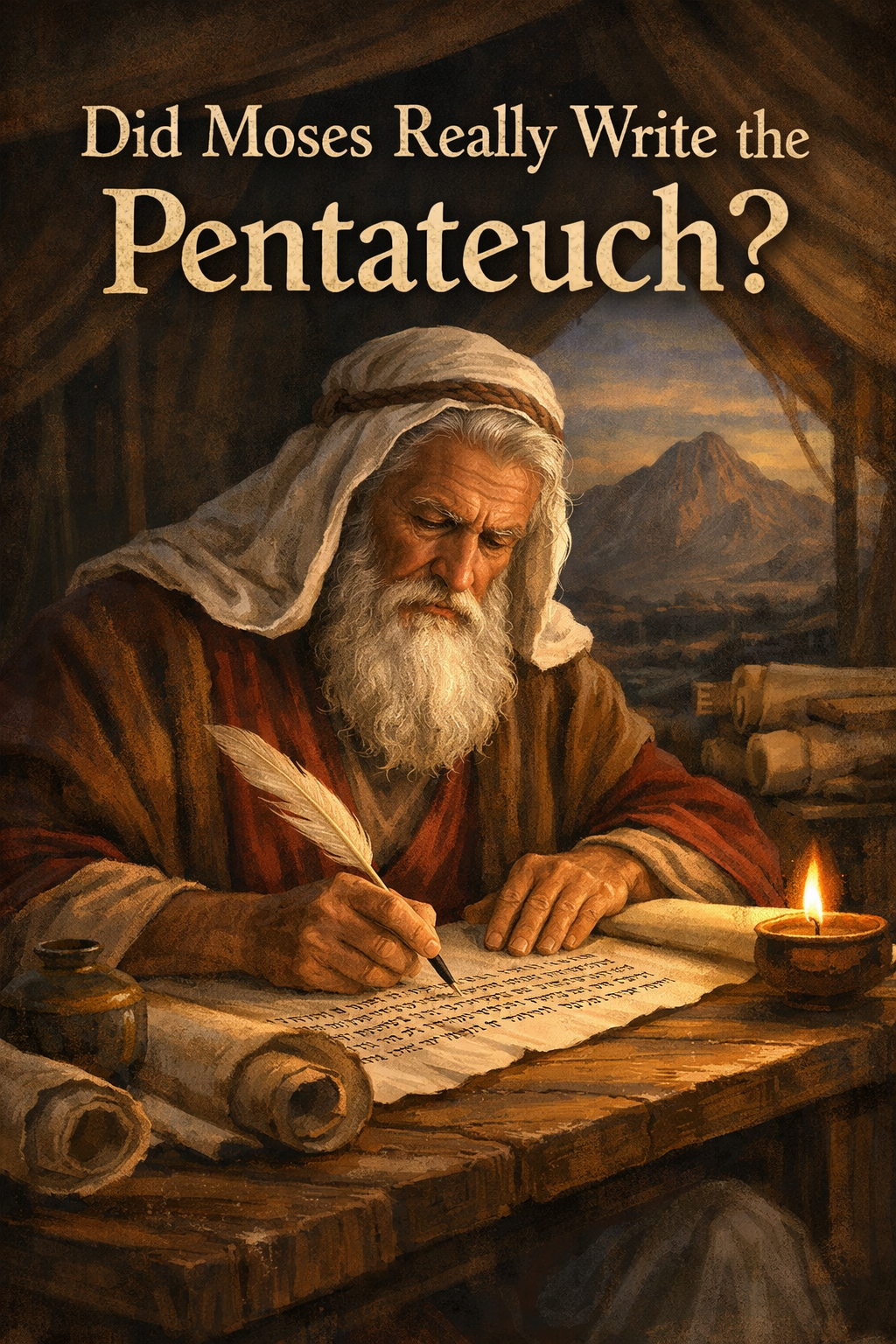
The question of who authored the Pentateuch, the first five books of the Bible (Genesis, Exodus, Leviticus, Numbers, and Deuteronomy), has generated significant scholarly debate since the Enlightenment and the rise of critical scholarship. While modern critical theories often attribute these books to multiple sources compiled over time, a strong case can be made for Mosaic authorship based on biblical testimony, historical tradition, internal textual evidence, and theological coherence. This view does not necessarily claim Moses handwrote every word. For example, it is unlikely that Moses wrote the passage in Deuteronomy about his own death. However, it affirms that he is the primary author responsible for the core content of the Pentateuch.
Biblical Testimony
The most direct evidence for Mosaic authorship comes from the Pentateuch itself. Several passages explicitly state that Moses wrote down laws, narratives, and covenants. For example, Exodus 24:4 says, “Moses wrote all the words of the Lord,” and Deuteronomy 31:9 records that “Moses wrote this law and gave it to the priests.” These internal claims are consistent and widespread, suggesting that the text presents Moses as its central human author.
Additionally, the rest of the Old Testament affirms Mosaic authorship. Joshua 8:31 refers to “the Book of the Law of Moses,” while 2 Kings 14:6 cites “the Book of the Law of Moses” as authoritative. These references indicate that ancient Israel consistently understood the Pentateuch to be Mosaic in origin. The New Testament further reinforces this perspective; Jesus Himself refers to the writings of Moses (John 5:46–47), as do other New Testament authors (Romans 10:5). Such consistent attribution across centuries strengthens the traditional view.
Historical and Jewish Tradition
Jewish tradition has long held that Moses authored the Torah. From early rabbinic writings to later Jewish scholars, Mosaic authorship has been treated as a foundational belief. Importantly, this tradition predates modern critical approaches by many centuries. While tradition alone does not prove authorship, its consistency across time suggests that the attribution was not arbitrary but rooted in a genuine historical tradition.
Furthermore, the Pentateuch reflects an ancient Near Eastern context consistent with the second millennium, the traditional timeframe of Moses. Legal codes, covenant structures, and social customs found in the text align with what is known from that period, supporting the plausibility of a Mosaic origin.
Internal Coherence and Eyewitness Detail
The Pentateuch contains numerous details that suggest firsthand knowledge of the events described. For instance, the wilderness narratives in Exodus and Numbers include specific geographic references, travel routes, and camp arrangements that would be difficult for a much later writer to reconstruct accurately. The descriptions of Egyptian customs and terminology, especially in Exodus, indicate familiarity with that cultural setting, consistent with Moses’ upbringing in Egypt.
Additionally, the unity of theological themes across the five books argues for a single guiding author. Central ideas such as covenant, law, holiness, and God’s relationship with Israel develop progressively and coherently. While variations in style and vocabulary exist, these can be explained by differing contexts and genres rather than multiple independent authors.
Addressing Challenges
Critics often point to features such as duplicate accounts, stylistic differences, and editorial elements as evidence against Mosaic authorship. However, these do not necessarily undermine the traditional view. Ancient authors frequently used sources, repetitions, and varied styles to emphasize theological points. For example, in Genesis, there are 11 toledots (usually translated something like “These are the generations”) that provide structure to the book. As Moses was not alive to serve as an eyewitness to these events, it makes sense that these toledots were probably ancient records of the events of Genesis that Moses compiled when writing the book. It does not impact his role as the author or the inspiration of the book through the Holy Spirit, as he still had to collect, organize, and even supplement these accounts under the inspiration of the Holy Spirit.
Moreover, it is entirely reasonable that later inspired editors or scribes made minor additions or updates without negating Moses’ primary role as author. The account of Moses’ death, for example, could have been written by Joshua or another close associate. This kind of supplemental editing is common in ancient literature and does not contradict the idea that Moses authored the bulk of the material.
Theological Significance
Affirming Mosaic authorship is not merely an academic exercise; it also has theological implications. The Pentateuch serves as the foundation of biblical law and theology. Viewing Moses as its primary author underscores the direct revelation of God to Israel through a chosen prophet. It reinforces the unity of Scripture and the continuity between the Old and New Testaments, where Jesus and the apostles treat the Law of Moses as authoritative.
Conclusion
While modern scholarship has raised significant challenges about the authorship of the Pentateuch, the evidence for Mosaic authorship remains substantial. The internal claims of the text, the consistent testimony of Scripture, longstanding Jewish and Christian tradition, and the coherence of the material all point toward Moses as the central authorial figure. Allowing minor editorial additions does not diminish this conclusion. Ultimately, Mosaic authorship provides a historically grounded framework for understanding the origins and authority of these foundational biblical texts.
About the Author
Daniel Sloan, Ph.D.

Dr. Daniel Sloan is a professor of Biblical Studies and serves as the online Director of the Master of Arts in Biblical Studies and Master of Arts in Biblical Exposition at Liberty University. He has a PhD in Theology and Apologetics with a concentration in Old Testament from Liberty University. He also serves as the Pastor of Family Life at Fairfield West Baptist Church in Fairfield, Ohio. He served as the Managing Editor and Contributor on the Thomas Nelson Evangelical Study Bible (Spring 2023).