
By Deanna Huff, Th.M., Ph.D. | January 18, 2026
The Christian Bible is the most sold book in the world. Simultaneously, discussions constantly arise over the reliability of the Scriptures. “It has been translated, forbidden, feared, argued over, abused, died for, and above all, treasured.”[1] The late Nabeel Qureshi, a former Muslim who converted to Christianity and became a defender of the faith, wrote, “The most common accusation against the Christian Bible is that the text has been changed over time." [2] These accusations imply the Bible is unreliable. In the past, I shared a brief article on how to start a conversation about the Bible’s trustworthiness using the acronym ICE.[3] The letters of ICE refer to internal evidence, changeless text, and external evidence. Let’s take a closer look at the confidence we can place in a changeless text. We can have a high degree of certainty that the Bible is reliable based on the textual witness of the Masoretic Text and the Dead Sea Scrolls.
The Masoretic Period
Prior to the 1947 discovery of the Dead Sea Scrolls (DSS), the tenth-century Masoretic Text (Leningrad Codex) was the most complete manuscript of the Hebrew Bible. “Almost all modern English translations of the Hebrew Bible or Old Testament are based on the Masoretic Text (MT).”[4] Many people have wondered whether the Bible we have today conveys the same theological message as the ancients did. The Masoretic period spans from the ninth century AD to the Middle Ages. The Masoretes were Jewish scribes and scholars. They copied the Scriptures and handed them down. Originally, the Hebrew Bible was written only in consonants, without vowels. In the absence of vowels, some words could have different meanings; context would provide clarity. Peter Flint provides an English example to illustrate the importance of vowels. If you only saw the consonants dg within a non-vowel system, then you could read it as dog, dig, or dug, depending on which vowel you inserted.[5] The Jewish Masoretes added the vowel system to the Hebrew Bible to clarify meaning. These types of additions and many variants in the copying process led people to question whether the Bible's message had changed over time, until the discovery of the Dead Sea Scrolls.
The Dead Sea Scrolls Period
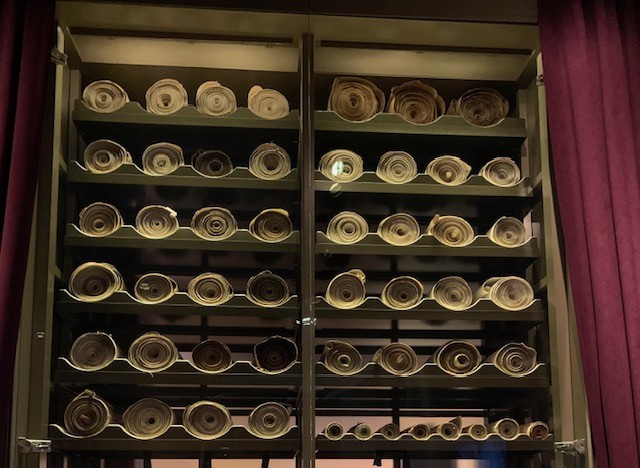
The Dead Sea Scrolls, dating from 250 BC to AD 130, have been considered the greatest archaeological discovery. Thousands of fragments and scrolls were found in the Qumran caves. Meade and Gurry state, “archaeologists have discovered several caves that had manuscripts in them. Of about 900 manuscripts discovered at Qumran, around 210 give us fragmentary remains of every biblical book except Esther.”[6] The Great Isaiah scroll (1QIsaa), dating to 125-100 BC, is one of the most discussed because it emerged virtually intact. Isaiah was a popular book at Qumran, with 21 other Isaiah manuscripts recovered. The DSS agrees uniquely with the MT. The Great Isaiah scroll shares over ninety percent of the likeness with the MT. Yet it is important not to minimize the fact that there are scribal errors and variants that scholars must recognize and make sense of. Scribes were at times prone to update language and, in the rigorous process, make mistakes. Changes and scribal errors do not imply that the Bible is unreliable; rather, the plethora of manuscripts, despite the variants, helps reveal that the Bible's message is intact.
In Conclusion
The MT and the DSS provide a high degree of certainty that the Scriptures we study today hold the same message as the scrolls did prior to Jesus. The Jews were faithful to copy the Hebrew Scriptures and pass them down to us. Although the writings have scribal updates, flaws, and variants, the Bible’s theological message remains unchanged. So, when the question surfaces, “Is there support for the reliability of the Bible?” then we can answer with confidence, yes! We have reason to believe that the Scriptures we carry convey the same theological message as those of the Jews before Jesus. We can share the message of the Old and New Testaments—God is holy, man is sinful, and in need of a Savior. One day, all those who repent and turn to Him will live with Jesus in the new heaven and new earth, where there is no more suffering and peace forever.
About the Author

Deanna Huff is a wife and mother. She is passionate about teaching others to share and defend their faith, drawing on 25 years of experience in the field. Her publications include The Prophets’ Use of the Shepherd Motif and Its Contribution to Their Presentation of the Character of God, and she has contributed chapters to Why Creationism Still Matters and Strong Faith.
She is also a speaker who has led seminars for the Baptist General Convention of Oklahoma, the Oklahoma Ladies Retreat, and the State Evangelism Conference. In addition, she taught high school students for ten years at Christian Heritage Academy, covering subjects such as Bible, Universal History, Apologetics, and Philosophy.
Deanna earned a Ph.D. in Theology and Apologetics at Liberty University. She holds a Master of Theology in Apologetics and Worldview from Southern Baptist Theological Seminary, a Master of Divinity with Biblical Languages from Southwestern Baptist Theological Seminary, and a Bachelor of Arts from the University of Oklahoma.
Deanna is an active member of Capitol Hill Baptist Church, where she hosts a podcast called Encouraging & Equipping. She and her husband teach an adult Sunday school class, discipling others in the faith.
Notes
[1] John D. Meade and Peter J. Gurry, Scribes & Scriptures (Wheaton, Ill: Crossway, 2022), 18.
[2] Nabeel Qureshi, No God But One (Grand Rapids, MI: Zondervan, 2016), 117.
[3] Deanna Huff, “Three Reasons to Believe in the Reliability of Scripture,” Bellator Christi, December 18, 2022, https://bellatorchristi.com/2022/12/18/three-reasons-to-believe-in-the-reliability-of-scripture/.
[4] Peter W. Flint, The Dead Sea Scrolls (Nashville, TN: Abingdon Press, 2013), 36.
[5] Flint, The Dead Sea Scrolls, 37.
[6] Meade and Gurry, Scribes & Scriptures, 66.