

Sherene Khouri, Ph.D. | December 28th, 2025 (Edited December 29, 2025)
The biblical date of Jesus’ birthday is not stated directly in the Gospels. The writers mention that Jesus was born under the Roman emperor Caesar Augustus, Judea’s local king, Herod the Great, but they do not mention what day or month the birth of Jesus took place. The earliest Christian source that mentions it belongs to the early fourth century, and it had two dates: Western and Eastern dates. These dates are still celebrated today under the Western and oriental churches all over the world. Today, the Western Christmas date is December twenty-fifth, and the Eastern date is January sixth.
The Historical Religious Theory
There are two major theories: the Historical Religious Theory (HRT), which was popularized by Hermann Usener (1834-1905). It suggests that Emperor Aurelian made the sun god Sol Invictus the chief deity of Rome and set his festival on December twenty-fifth. Later, the early Church adopted this date, reshaping the pagan “birth of the sun” at the winter solstice into the celebration of Christ’s birth. Christian art and writings from that time often connect Jesus with the sun, calling him the “true sun” or linking him to “the sun of righteousness” (Malachi 4:2 KJV). In this view, Christmas became a Christian alternative to pagan festivals, giving them new spiritual meaning. Some even argue that stories of Jesus were influenced by figures like Osiris, Mithras, or Horus, and that December twenty-fifth was chosen to replace the pagan holiday of Sol Invictus, the “Unconquerable Sun.”
Calculation Theory
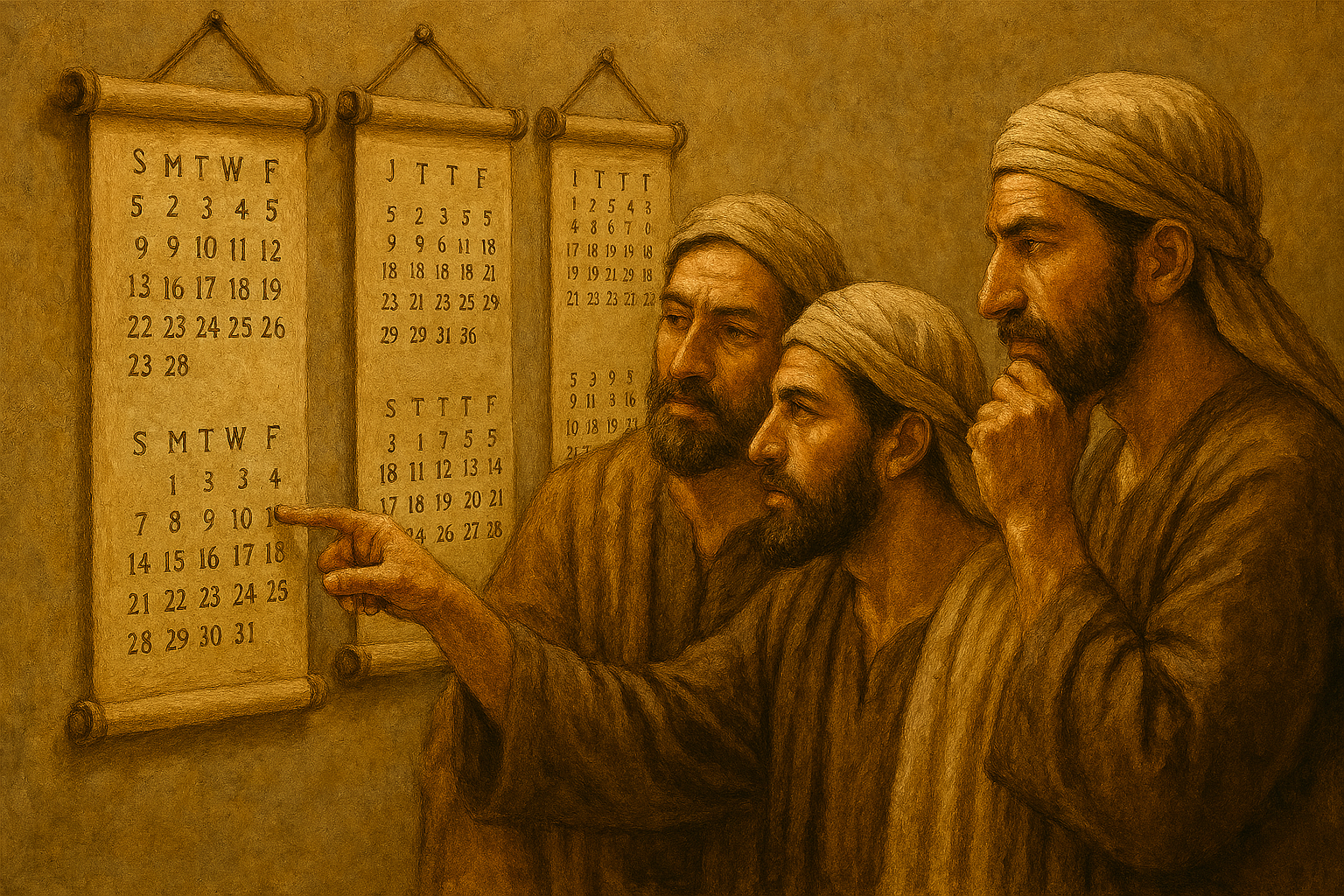
The second theory is called the Calculation Theory (CT). This theory was introduced by Louis Duchesne in the late 1800s. He argued that December twenty-five as Christ’s birthday was not chosen to replace a pagan festival, but rather calculated from the date of Jesus’ death. In Jewish tradition, there was a belief called “integral age,” meaning that prophets often died on the same day they were conceived or born. Early Christians thought Jesus died on March twenty-fifth (according to the Gregorian calendar). Following this idea, Duchesne reasoned that Jesus’ conception (the Annunciation) also happened on March twenty-five. Counting nine months forward places his birth on December twenty-five.
Some years later, liturgical historian Talley argued that following the Johannine chronology, which seems to place Jesus’s death on the eve of the Passover, the first Jewish believers would likely have observed the Pasch (Easter) on the evening of Nisan fourteen (according to the Jewish calendar), not the following Sunday. After the Jewish war with Rome (AD 66–70), Jewish believers were scattered and many resettled in Asia, joining the churches mentioned in the book of Revelation. After Jerusalem’s destruction, there was no central authority to fix the date of Passover. According to Tally, Quartodeciman Christians in Asia, who adopted the Julian calendar as the equivalent to the Jewish date of the Passover, would have celebrated April sixth as equivalent to Nisan fourteen when Jesus was crucified. It is also viewed as the date of his conception. Counting nine months forward gave January six, the original date of celebrating Christ’s nativity in the East (Epiphany).
Conybeare offers another reason for emphasizing the epiphany instead of the birth of Jesus. John Chrysostom and Cassian describe the new feast as the birth according to the flesh, while implying that there is also a birth according to the spirit. Conybeare concludes that the second birth refers to Jesus’ baptism, known today as the Epiphany. He states, “Nicetas says that ‘its principle and cause is the baptism of Christ.’ Gregory, the wonder-worker, writing in the third century, calls it the day of the holy theophany … Hippolytus, at the beginning of the same century, calls the festival by the same title.” Conybeare explains that early Christian writers such as Polycarp (in the second century), Melito in his Ad Eutropium, (also second century), and Hippolytus and Cyprian in the first half of the third century appeal to Luke’s gospel. Luke claims that Jesus was beginning his thirtieth year when he came before John for baptism, which suggests that he was baptized on his thirtieth birthday. Thus, it is proper to celebrate his baptism and his birth on the same day.
What did the early fathers of the church say about the date of Christmas?
Kurt Sommons suggests that the Christmas date may not have been of major importance in the first two centuries; however, the early patristic fathers who addressed it often employed symbolic association, particularly through the use of solstices and equinoxes. Irenaeus (AD 130-200) makes no reference to a feast for Christ’s birth. Tertullian (AD 160-225) places Jesus’ birth in two B.C. but likewise omits any mention of such a festival, while Origen (AD 165–264) ridicules Roman birthday celebrations as pagan practices. Many early fathers’ claims about Jesus’s birth occurred before Constantine declared Christianity the state religion and transformed Rome’s traditional gods into a new Christian and spiritual framework. This is why December twenty-fifth cannot be a pagan or Roman celebration that Christians adopted later.
Julius Africanus (AD 160-240) is known as the earliest Christian chronographer. He equated March twenty-fifth with Passover day, the fifteenth day and full moon of the first lunar month. He assigned March twenty-fifth as Jesus’s conception and incarnation date, and therefore his birth is December twenty-fifth. He worked out a triad of March twenty-fifth—December twenty-fifth—March twenty-fifth, marking the conception, birth, and resurrection of Christ.
Hippolytus (AD 170–235) sets the first day of creation on March twenty-fifth and Christ’s death on Nisan fourteen, saying he did not eat, but suffered the Passover. He states in his Chronicon: “From Adam until the transmigration into Babylon under Jeconiah, 57 generations, 4,842 years, 9 months. And after the transmigration into Babylon until the generation of Christ, there were 14 generations, 660 years. Fifty-five hundred two years and nine months from creation, March 25th places the birth of Christ on December 25th.” Additionally, in his commentary on Daniel, Hippolytus states, “The first coming of our Lord, that in the flesh, in which he was born at Bethlehem, took place eight days before the Kalends of January (i.e. on December 25th), a Wednesday, in the forty-second year of the reign of Augustus, 5500 years from Adam [Commentary on Daniel 4, 23].”
Finally, the constitution of the holy apostles, which was written in the 4th century, states,
“Brethren, observe the festival days; and first of all the birthday which you are to celebrate on the twenty-fifth of the ninth month; after which let the Epiphany be to you the most honoured, in which the Lord made to you a display of His own Godhead, and let it take place on the sixth of the tenth month.” This shows that the early fathers were not acting arbitrarily or inventing traditions without a basis. Instead, their reasoning was shaped by the Passover date, Jesus’s resurrection, and the winter solstice, which would naturally place his conception on or near the vernal equinox. Christ’s birth date was not derived from Roman traditions or conversions.
Conclusion
This article challenges the Historical Religious Theory (HRT), which claims Christmas developed as a Christian response to a Roman pagan festival. Evidence from early Christian writers undermines this view and suggests Christmas was not yet part of the ecclesiastical calendar nor a widespread observance among Christians, and if it had existed, it would not have been linked to pagan customs. The article also explains why some Eastern churches commemorate Christmas on April sixth.
About the Author
Sherene Khouri was born into a religiously diverse family in Damascus, Syria. She became a believer when she was 11 years old. Sherene and her husband were missionaries in Saudi Arabia. Their house was open for meetings, and they were involved with the locals until the government knew about their ministry and gave them three days’ notice to leave the country. In 2006, they went back to Syria and started serving the Lord with RZIM International ministry. They traveled around the Middle Eastern region—Turkey, Jordan, Egypt, Lebanon, Syria, and United Arab Emirates.
Sherene was also involved in her local church among the young youth, young adults, and women's ministry. In 2013, the civil war broke out in Syria. Sherene and her husband’s car was vandalized 3 times and they had to immigrate to the United States of America. In 2019, Sherene became an American citizen.
Sherene is an Assistant Professor at Liberty University. She teaches Arabic, Religion, and Research classes. Additionally, she holds a Ph.D. in Theology and Apologetics, M.A. in Christian Apologetics from Liberty University, and B.S. in Biblical Studies from Moody Bible Institute. Currently, Sherene is also working on a Master of Theology in Global Studies at Liberty University and M.A. in Arabic and linguistics from PennWest University.
Notes
Beckwith, Roger. “St. Luke, The Date of Christmas and the Priestly Courses at Qumran.” Peeters Publishers. Vol 9. No. 1 (January 1977): 73-94.
Conybeare, F. C. “The History of Christmas.” The American Journal of Theology 3. No. 1 (1899): 1–21.
Larsen, T. Ed. The Oxford Handbook of Christmas. Oxford: Oxford University Press, 2020.
Nothaft, P. E. “The Origins of the Christmas Date: Some Recent Trends in Historical Research,” Church History 81. No. 4 (12, 2012): 903-11.
Schaff, Philip. The Constitution of the Holy Apostles. Book V. Section III. https://www.ccel.org/ccel/schaff/anf07.ix.vi.iii.html#:~:text=A%20Catalogue%20of%20the%20Feasts,that%20are%20about%20to%20perish.
Simmons, Kurt M. “The Origins of Christmas and the Date of Christ’s Birth.” Journal of the Evangelical Theological Society 58. No. 2 (2015): 299-324.
Talley, Thomas J. Origins of the Liturgical Year. New York: Pueblo, 1986.