
By: Anthony Williams | November 30, 2025
Disclosure: This article is rated PG-13. If you are 13 or under, please get permission from a parent or guardian before reading. See also the following resources written on St. Nicholas of Myra: The Real Saint Nicholas (Parental Warning: The Truth is Revealed) - Bellator Christi, The Genuine Saint Nicholas - Bellator Christi.
As we approach Christmas, Christians are again faced with the question of who Santa is, or is not. What does this “jolly old elf” have to do with the birth of Christ that we are supposed to be celebrating? Is it a very thinly veiled attempt to steer attention away from the celebration of the birth of Christ with a fictional character whose name is an anagram of Satan?
The Myth
Like most others in my generation, I was told that Santa was a magical elf who knew all my naughty and nice behavior. He’s keeping a list and checking it twice, and if I am not careful, he won’t bring me any presents during his annual one-night gift-giving spree across the world. While the holiday was designated to be a celebration of Christ’s birth, the Santa element has become to many the overriding theme of the season.
Recent history shows that the modern version of Santa is largely based on poems and commercial advertising. 19th-century writer Washington Irving describes “Saint Nicholas” visiting his favorite children once a year in his 1809 book, Knickerbockers A History of New York. The mention of St. Nicholas was a memory of the traditions that were a part of New Amsterdam’s Dutch immigrants. This story mentions the tradition of stockings hung by the fireplace, which would be filled with gifts on the morning of Christmas. If you read it right, you can see that the name Santa Claus is actually a transliteration of Saint Nicholas from Dutch to modern English.
Later, the poem, "A Visit from St. Nicholas" was written by Clement Moore for his six children in 1823. The poem, which begins with, “Twas the night before Christmas…”, quickly became a book and was widely distributed in the U.S. In 1930, Coca-Cola hired a well-known artist named Haddon Sundblom to paint an image of Santa drinking a Coke. This became an annual tradition and helped shape the image of Santa for generations. The real Santa, and the life that gave rise to our traditions today, goes back much further than the 19th century.
The Man
The Santa Claus we know today is ultimately based on a real man called Saint Nicholas of Myra, who was born in approximately 270 A.D. Myra was a coastal city in modern-day Turkey, which was culturally Greek at the time. The region is often called Asia Minor, and also includes the seven churches mentioned in the Biblical Book of Revelation.
Nicholas was born to a wealthy family, but lost his parents at a young age. Nicholas is said to have traveled to the Holy Land as a young man to walk where Jesus walked. He was known to be extremely generous to those in need, following Jesus’ command to another young rich man to sell all he had and follow Him. (See Matthew 19:16)
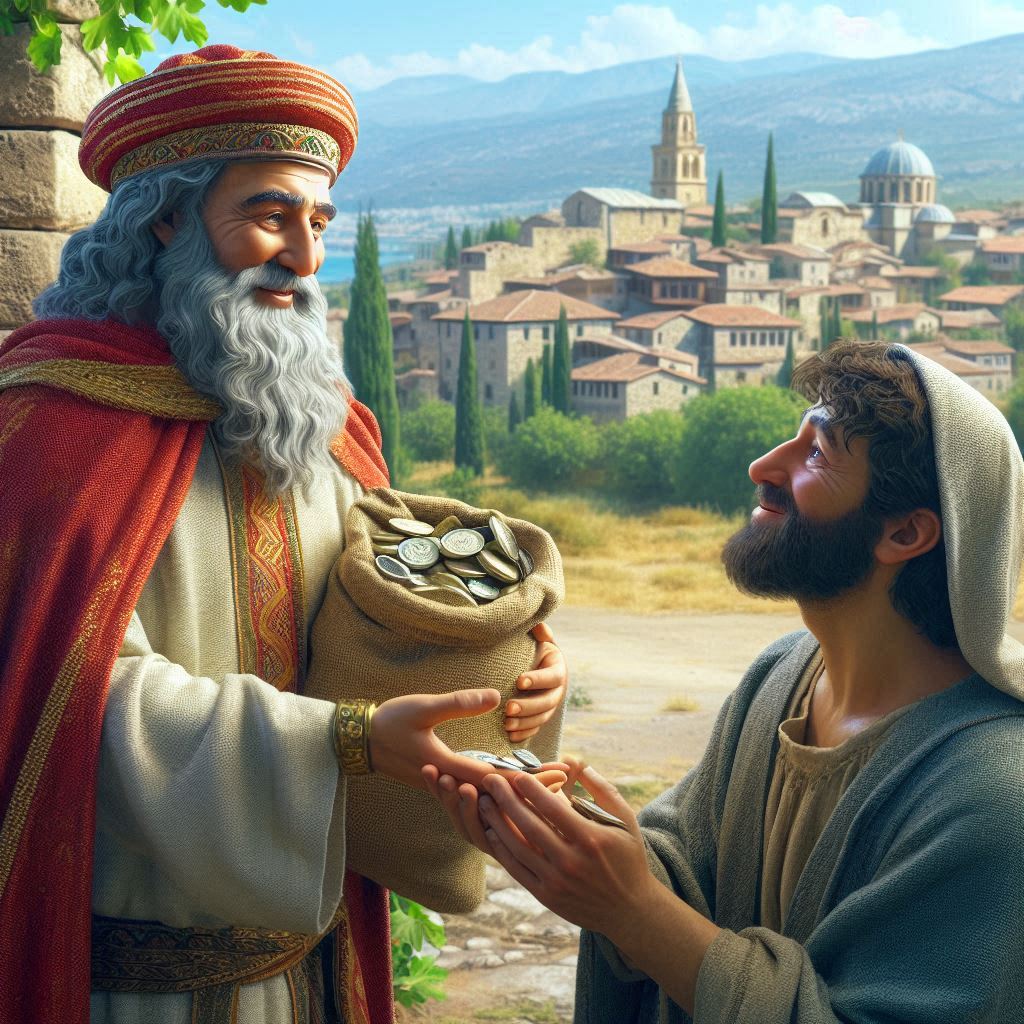
One story of Nicholas recounts how three daughters were in danger of being forced into indentured servitude due to debts owed by their father. Over the course of time, bags of gold would appear in the shoes warming near the fireplace of the home. Eventually, Saint Nicholas was spotted secretly throwing the money into the shoes from a window. He wished to remain anonymous in his giving so that God would get the glory. (1)
Saint Nicholas was not just a kind man. He was also a staunch defender of the Christian faith. His zealous faith would lead to him being named Bishop of Myra in 300 A.D. This was a dangerous assignment, as many Christians were being persecuted by Rome. Within three years, Nicholas was imprisoned by the Roman emperor Diocletian during a time when it is written that Roman prisons were so full of Christians that murderers and other serious criminals were released to make room.
Nicholas was released in 313 A.D. In 325, he attended the Council of Nicaea, which was a conference of Christian leaders who met to address a heresy that came to be known as Arianism. This was the belief posed by a leader named Arius that Jesus was not divine. Legend has it that Nicholas became so enraged at Arian for denying Christ’s divinity that he slapped him during the conference. Ultimately, Arianism was rejected by the church leaders. The Council of Nicea was convened by Emperor Constantine and is responsible for establishing the Nicean Creed that helped the persecuted, but fast-growing faith remain clear about the core beliefs of Christianity during its early years of expansion. Nicholas died in approximately 343 A.D. He was venerated as a saint, and his tomb at the church in Myra became a popular pilgrimage site for Christians for centuries.
Over time, St. Nicholas Day came to be celebrated on December 6th, the date on which he died in 343 A.D. Gift giving became a popular tradition on this day. December 25th had become established as a date to celebrate the birth of Christ by the mid-4th century. Later, Martin Luther worked to move St. Nicholas Day to December 25th to remind protestants that all gifts come from Christ, whose birth was celebrated on that day each year. In Luther’s Germany, the word Christkindl, which meant Christ Child, became associated with December 25th. Later, this word would be morphed into Kris Kringle, which you may recognize as an alias for Santa Claus. (2)
The memory of St. Nicholas continued to be an important part of the Christian heritage, especially in Eastern Europe and Asia Minor. In 987 A.D., before Russia was Russia, Grand Prince Vladimir brought Christianity to the Kyivan Rus (modern Ukraine). After the Great Schism (1054) divided the Church into the Latin-speaking Catholic West and the Greek-speaking Eastern Orthodox East, Nicholas remained a significant figure in the East.
In the 11th century, much of Eastern Europe would fall to Islamic conquest by the Seljuk Turks. To avoid the likely desecration of his tomb, St. Nicholas’ remains were smuggled to Bari, Italy, where his tomb remains to this day. Most of Asia Minor would fall to Muslim rule, including all seven churches mentioned in the Book of Revelation.
There are many more twists and turns in the story of Bishop Nicholas of Myra that we don’t have room to cover in this short article. So, why does it matter, and why should a Christian care about a man who has been dead for over 1,650 years? I believe there are two reasons: truth and kindness.
Truth
Nicholas was a man who demonstrated his faith in a time when there was extreme persecution against the relatively young Church. He fought for the truth of Christ’s divinity as was handed down from those who lived with Him in the face of influential leaders within the church who wanted to water down who Jesus was. He is a good role model for Christians living today who see the same attempts to diminish the power and truth of God’s authority and Christ’s atoning work on the cross.
Kindness
Nicholas was also extremely generous with all that he had and cared for those who were without. This is true for material needs like food and clothing, which are extremely important to human beings. But for the Christian, we have more to offer than just clothes and food. We have the Way, the Truth, and the Life that leads to the forgiveness of sins and a hope for an eternity in the presence of our Creator. It is certainly a kindness to give material objects, but we should also remember the unbelievable kindness of our Creator to lay down His life for us. This kindness, which none of us deserves, should certainly inspire us to share the gift of salvation with other sinners.
Glory to God
This Christmas, which is meant to celebrate the birth of Christ, we are reminded that even the origin story of Santa Claus gives glory to God. This real man gave away his worldly goods to help others in need, went to prison for his faith, and fought for the truth of the gospel. In sharing this real story of St. Nicholas with others this Christmas, we can help lead them to the Savior.
Santa hasn’t given anyone any presents for many centuries, but he should point us back to the true giver of all gifts. If we know the truth about the man behind the myth of Santa, it leads us on Christmas to the manger of the Christ Child who was born to die for all who would simply repent and believe in Him for the gift of salvation. I pray that if you haven’t yet, you would receive the gift of faith from the Giver of all good gifts this Christmas.
-
For a great summary that goes further, see William Federer’s great summary at https://americanminute.com/blogs/todays-american-minute/how-saint-nicholas-turned-into-santa-claus
-
More information about the man St. Nicholas can be found at the St. Nicholas Center website: https://www.stnicholascenter.org/who-is-st-nicholas
- See also, Brian G. Chilton, "The Genuine Saint Nicholas," BellatorChristi.com (December 9, 2019), The Genuine Saint Nicholas - Bellator Christi.
(c) 2025. Bellator Christi.





Great article, my friend! Merry Christmas!