
By: Thomas McCuddy, DMin | September 28, 2025
With recent events revolving around the assassination of Charlie Kirk and the murder of Iryna Zarutska, we have renewed discussions on what kind of people we should be. Part of our problem as a society follows from bad examples lauded in university lectures and Reddit forums. Therefore, it seems a short examination of two of these bad examples examined in theory will help us understand modern events in practice.
False Strength and False Softness
Every age sketches a picture of the ideal man. Ours often offers two caricatures. One is hard as iron, the self-authoring conqueror who bends the world to his will. The other is soft as a pillow, the emotionally curated nice-guy who avoids conflict in the name of kindness. However, the Gospel forms a third kind of man entirely: a virtuous disciple of Jesus whose strength is ordered
by love and whose love is governed by truth.
What We Mean by Virtue and Discipleship
Virtue is not just some buzzword and is much more than the pejorative adjective found in “virtue signaling.” Virtue is a stable excellence of soul, a habit by which a person consistently aims at the true good. Likewise, a disciple is a believer who conforms to the image of Jesus in thought, desire, and action. Bring those two together, and you have the aim of Christian formation, which is a person whose mind is renewed, whose desires are retrained, and whose hands do the good because the heart has learned to love it.
The Problem with the Superman
On the one side, we have the red-pilled, hard man portrayed by Friedrich Nietzsche’s Übermensch, which is often translated as “superman.” He is far from a comic book hero. He is a
person who transcends conventional morality by creating values through raw will. In the Prologue of Thus Spoke Zarathustra, Nietzsche puts it starkly: “I teach you the overman. Man is
something that shall be overcome.”
It sounds thrilling. Overcome the herd. Cast off the weak. Become lightning in a dark sky. However, this vision mistakes domination for excellence. If “the overman is the meaning of the
earth,” as other lines in the Prologue suggest, then the highest good is simply the strongest will. The weak exist to be surpassed. The neighbor is a rung on a ladder. The Gospel answers with a paradox. The Son of Man “came not to be served but to serve, and to give his life as a ransom for many.” Greatness, Jesus says, is found in becoming a servant. Authority is real, but it is cruciform. Power is real, but it kneels and washes feet. See Matthew 20:25–28 and John 13:1–5.
The philosophical problem runs deeper. If values are merely created by the will, then “good” has no anchor outside whoever currently possesses the loudest strength. The biblical vision anchors
good in God’s character and purpose. True greatness is measured by conformity to Christ, not conquest over others.
The Problem with the Softman
On the other side stands what we might call the softman. He takes his cues from a cultural project that treats masculine strength as a social problem to be defused. In practice, that often means avoiding hard truths, confusing niceness with love, and treating conflict as the worst of all evils. Aquinas had a word for this vice: effeminacy, literally “softness” (mollities). He does not refer to
simple mannerisms as in a limp wrist and a lisp. He means a soul that quits the hard good because it is hard. “Effeminacy,” he writes, is being “ready to forsake a good on account of difficulties which he cannot endure.” (Summa Theologiae II–II, q.138, a.1, respondeo). The softman wants virtue without sweat, leadership without weight, friendship without frankness, and holiness without a cross.
Modern discourse often rebukes “toxic masculinity,” sometimes helpfully calling out cruelty or exploitation. Yet many frameworks slide from condemning vice to suspecting manly strength itself, as if exhortations to courage, perseverance, and spiritual headship are thin disguises for harm. Even secular summaries of recent debates acknowledge how this rhetoric frequently casts traditional markers of masculine responsibility as suspect. Scripture takes a cleaner path. It condemns brutality and selfish ambition, then commands men to be strong in the right way: “Be watchful, stand firm in the faith, act like men, be strong. Let all that you do be done in love.” (1 Corinthians 16:13). That sentence refuses both counterfeits in one breath.
The Way of the Virtuous Disciple
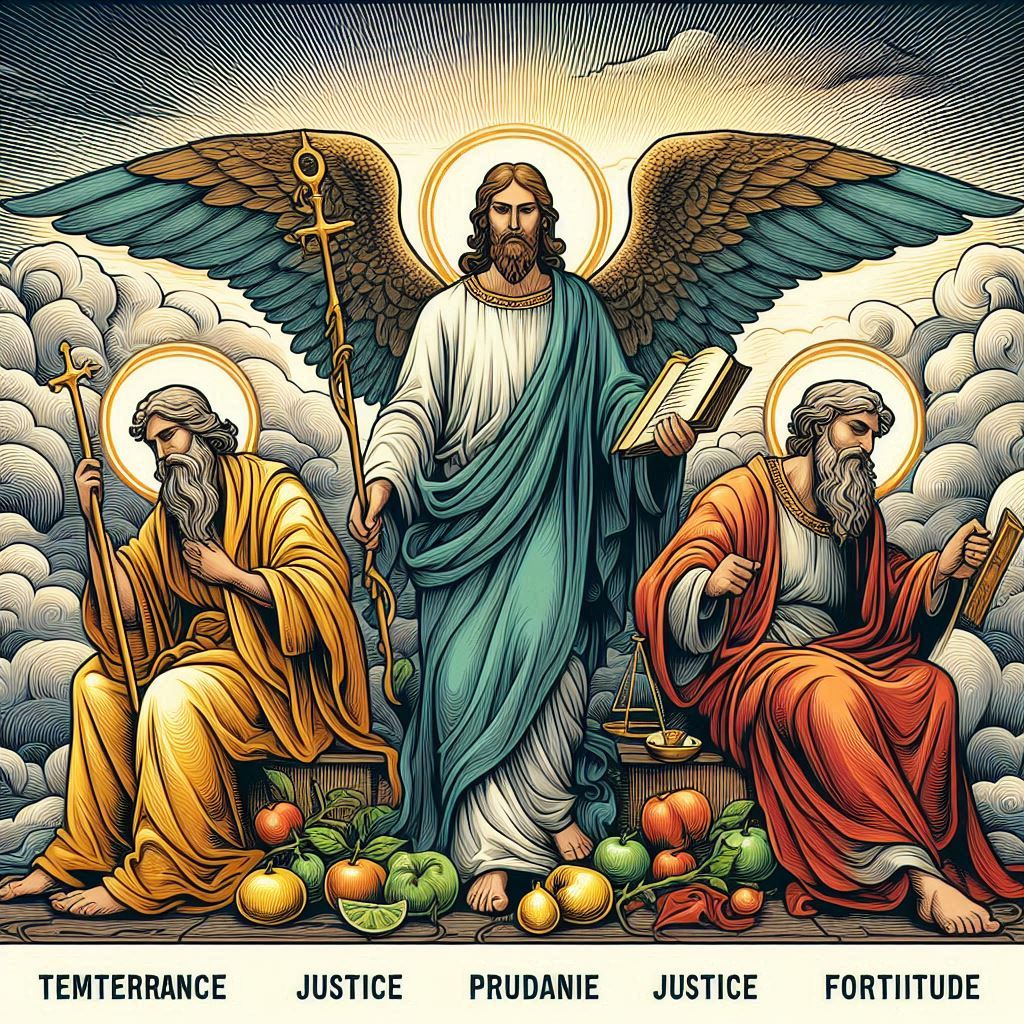
The virtuous disciple is neither the tyrant nor the timid. He is a man under authority and therefore a man fit to exercise it. Four classical virtues, fulfilled and elevated in Christ, sketch
the profile.
- Prudence discerns the right end and the fitting means. It starts with renewed minds, trained to test and approve what is good. Thus, prudence is the link between the mind
and hands with which we love God. It commands action when the time comes. - Justice gives each his due. It starts with God. Worship is justice toward the Lord. Honesty, fidelity, and keeping promises are justice toward our neighbor.
- Fortitude endures difficulty for the sake of the highest good. It is the antidote to both the superman’s cruelty and the softman’s retreat. Fortitude says, I will not drop the good
because it hurts. - Temperance orders desire. It teaches the body to serve the soul and the soul to serve God. Pleasure becomes a servant of love rather than a master of the will.
Watch Jesus and you will see perfect harmony as He confronts false teachers without swagger. He cleanses the temple without malice, and He carries a cross without self-pity. He is gentle and
lowly in heart, yet His words cut straight to the bone. He knows when to drive out money changers and when to wash feet. The world has never seen strength so meek or meekness so
strong.
Aquinas’s analysis helps here too. Where the superman dreams of self-exaltation, Christian magnanimity seeks great things for God. Where the softman flees pressure, Christian
perseverance stays at the plow. Where anger boils over or evaporates into silence, Christian meekness harnesses passion to charity. None of this is natural. It is the fruit of grace-forming
habits over time.
The Contemporary Connection
Without belaboring the point, we see in Kirk and the situation with Zarutska the good and the bad manifest. Starting with Zarutska, many thousands have lamented how no one came to her
aid and let her die. Whether or not intervention would have prevented her death is one issue, but the fact that we as a society are producing common people who refuse to act demonstrates
both a self-centered, “it’s not my problem,” and a fearful response of inaction.
Concerning Kirk, we see a man who fearlessly and fiercely engaged the culture with gentleness and respect (1 Peter 3:15). Kirk could do this consistently only because he already possessed
the virtues needed to face such situations. He regularly engaged anyone, without hesitation, and did so with respect and directness desperately needed in men and women who follow
Jesus. We as a society, and particularly as a church, would do well to learn from these examples, one the counter example of what not to do, and one the exemplar of how work within
our God-given spheres of influence.
The Cross that Makes Men
At the center of Christianity stands not a throne of iron but a wooden cross. There the false strength of the superman is unmasked by a King who lays down His life. There the false
softness of the softman is rebuked by a Savior who does not shrink from pain. The One who is in the form of God “emptied himself, by taking the form of a servant,” and humbled Himself to
the point of death. The risen Lord now defines greatness forever.
So, let us raise our sons and call our brothers to something better than domination and better than drift. Let us teach them to be servants with a lion’s heart and a lamb’s humility. The world
does not need more supermen or soft men. It needs men made strong by grace, steady in virtue, and happy to be called disciples.
About the Author
Thomas McCuddy, M.A., D.Min.
 Dr. Thomas McCuddy brings a wealth of ministerial experience to the team. Throughout Eastern North Carolina, Thomas has served in various pastoral roles. He heads the Apologetic Department at Carolina College of Biblical Studies. Additionally, he serves as the President of Families of Virtue Ministries and assists with various ministries in South Africa. Formerly, he worked with the late Dr. Norman Geisler at NGIM (Norm Geisler International Ministries).
McCuddy earned his Doctor of Ministry in Apologetics degree from Southern Evangelical Seminary along with other degrees from the school. Originally hailing from Memphis, Tennessee, Thomas is a graduate of Middle Tennessee State University, where he earned a degree in mathematics. Currently, he resides with his wife and children in Fayetteville, North Carolina.