
Difficult Conversations Matter
By Deanna Huff, Th.M., Ph.D. | August 31, 2025
Engaging in the Good and Bad
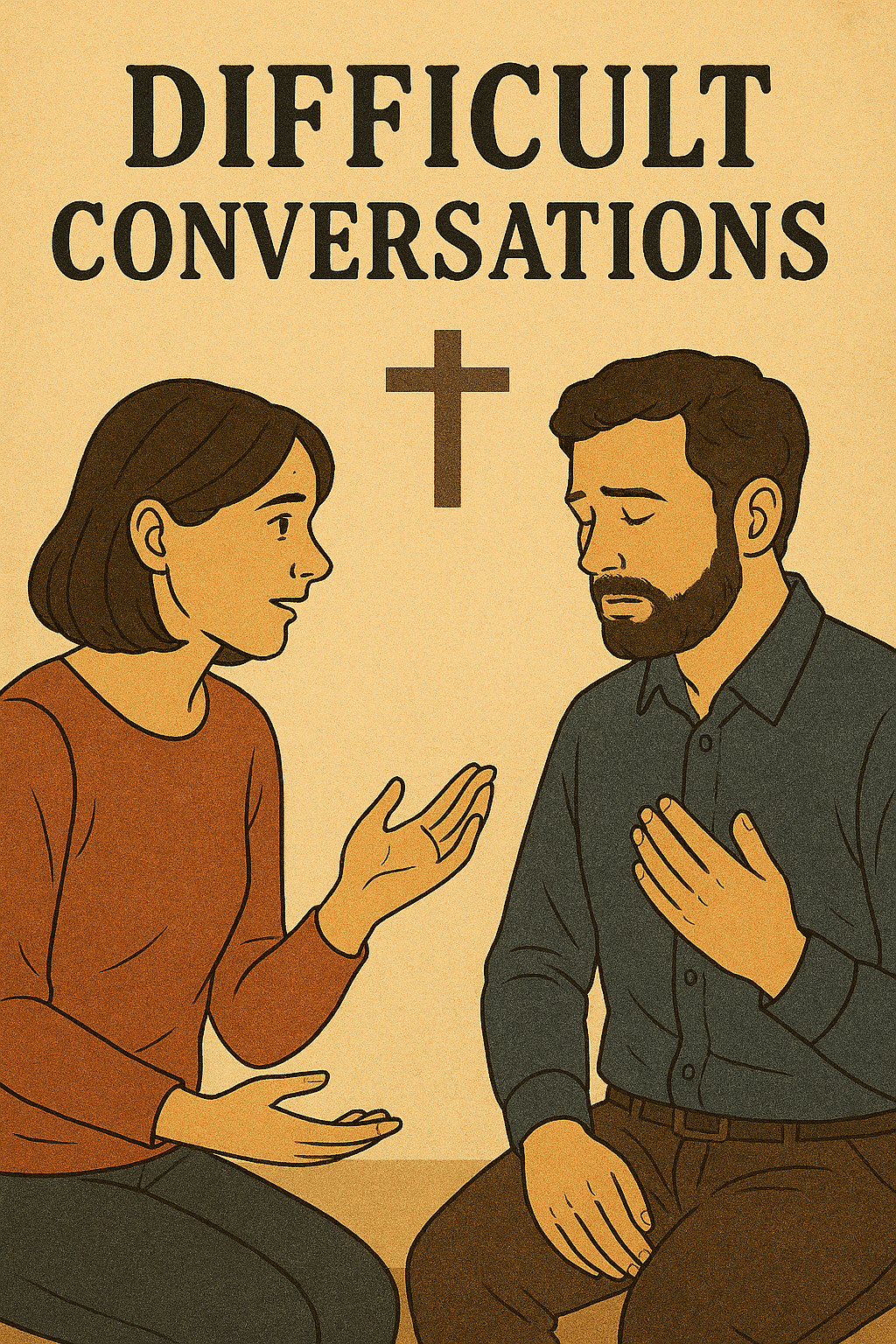
Starting discussions with people who see the world differently can sometimes feel intimidating and frustrating. As I was scrolling on social media, I saw a post that said the following: “Religion is fine as long as you don’t use it to tell anyone else how to live.” I was taken aback by the hypocrisy. It was telling me what to do, while telling me I shouldn’t do the same. This statement instructs people on how to live, but the author is claiming that religion shouldn’t do the same. Why should I listen to this claim, or why should it be rejected? Where do standards of living originate? How do I discuss uncomfortable yet important topics with people?
Engaging in these conversations can be a bridge to sharing God with others. Every day, friendly discussions about moral issues can open the door to discussing where those morals originate. Conversations are always happening. Whether they are on the news, social media, in calls, texts, emails, in movies, in classrooms, etc. Moral topics expose a standard of right and wrong, but where do we ground our morality? Who says what is good or bad? Cultivating these conversations gives the opportunity to share about the goodness of God.
Endorsing the Good
Where does the idea of right and wrong originate? People behave in ways that express there is some sort of way we ought to be acting. C. S. Lewis says, “It looks very much as if people have in mind some kind of Law or Rule of fair play or decent behavior or morality or whatever you like to call it.”[1] Disagreeing on an issue and then attempting to persuade someone that they are wrong makes no sense unless there is a right standard.
This can be seen when a bad call is made at a sporting event or when one hears someone play the wrong key on the piano. There is a standard that people are appealing to express that something has gone wrong. Many people would endorse the words of C. S. Lewis, “there is the human idea of decent behavior that is obvious to everyone… What is the sense in saying the enemy was in the wrong unless Right is a real thing?”[2]
This Law or Rule about right and wrong is sometimes referred to as the Law of Human Nature. If people claim there is no moral standard or Law of Human Nature, then it prevents people from doing two things: they cannot criticize cultures for something they believe is wrong, and they cannot promote moral reform. Humans have a sense of right and wrong.
Lewis said, “Whenever you find a man who says he does not believe in a real Right and Wrong, you will find the same man going back on this a moment later.”[3] Actions speak louder than words, and all of us act on what we believe. Humanity behaves as if there is a moral standard. Being willing to have conversations about why we act the way we do can open the door to discussing the good God who made us to live a moral and good life.
Establishing the Good Way
Through the words of the Bible, God gives us instructions for the right way to live. The right way is where people will find rest for their souls and meet Jesus, who can restore them. Jeremiah says, “ask for the ancient paths, where the good way is; and walk in it, and find rest for your souls” (Jer 6:16). And Jesus says, “I am the way, the truth and the life. No one comes to the Father except through me” (John 14:6). And he further stated that the greatest commandment is to love God with all your heart and to love your neighbor as yourself (Matt. 22:37-39).
Conclusion
God has given us instructions on how to live righteously. As His followers, we must be willing to engage in difficult conversations about how to live the right way. Ultimately, we are called to go out into the world and share the good news (Matt. 28:19-20). When you engage in moral conversations, you give yourself the opportunity to fulfill the great commission. There is a Law of Human Nature within us, and it originates with the Creator of the world. The Bible provides us with the way of right and wrong, but more importantly, the way to God.
About the Author
Deanna Huff, Th.M., Ph.D.

Deanna Huff is a wife and mother. She is passionate about teaching others to share and defend their faith, drawing on 25 years of experience in the field. Her publications include The Prophets’ Use of the Shepherd Motif and Its Contribution to Their Presentation of the Character of God, and she has contributed chapters to Why Creationism Still Matters and Strong Faith.
She is also a speaker who has led seminars for the Baptist General Convention of Oklahoma, the Oklahoma Ladies Retreat, and the State Evangelism Conference. In addition, she taught high school students for ten years at Christian Heritage Academy, covering subjects such as Bible, Universal History, Apologetics and Philosophy.
Deanna earned a Ph.D. in Theology and Apologetics at Liberty University. She holds a Master of Theology in Apologetics and Worldview from Southern Baptist Theological Seminary, a Master of Divinity with Biblical Languages from Southwestern Baptist Theological Seminary, and a Bachelor of Arts from the University of Oklahoma.
Deanna is an active member of Capitol Hill Baptist Church where she co-hosted a podcast called The Analysis with Pastor Mark DeMoss. She also co-hosted a podcast with her daughter Ellie Huff called but why should i care. She and her husband teach an adult Sunday school class, discipling others in the faith.
Notes
[1] C. S. Lewis, Mere Christianity, (London: Harper Collins, 2012) 4.
[2] Ibid, 5.
[3] Ibid, 6.
(c) 2025. Bellator Christi.