
Sermon on the Mount or Sermons on the Mount?
By: Brian G. Chilton, M.Div., Ph.D. | August 10, 2025
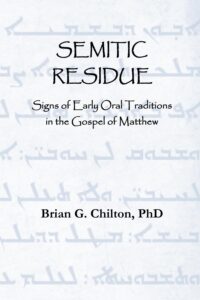
Recently, I published my fifth book (3rd solo work) called Semitic Residue: Signs of Early Oral Traditions in the Gospel of Matthew. The book is based on my PhD dissertation work. Though this work helped me earn the title “doctor,” my work with the material is only getting started. Semitic Residue searches for signs that the Gospels were based on early oral traditions accurately transmitted by the earliest Christian communities to the time when the four Gospels known today were documented. One of the sections that scored highest was a collection of material known as the Sermon on the Mount (Matt. 5–7).[1]
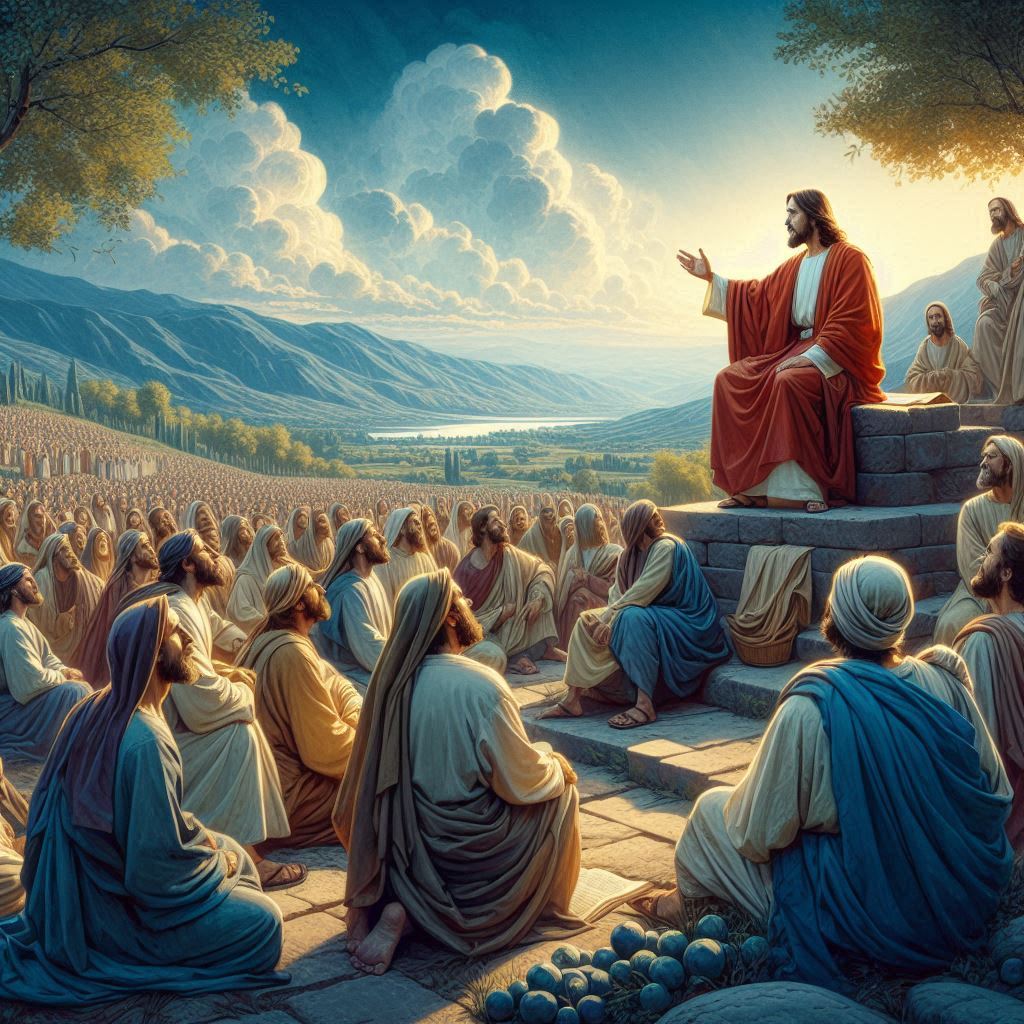
After finishing Semitic Residue, it dawned on me that the messages of Jesus in the Gospels were eerily reminiscent of the sermon summaries of Paul and Peter in the book of Acts. When looking at the Sermon on the Mount, it is striking to consider that the Sermon on the Mount is likely a collection of various sermons and teachings that Jesus gave on the mountain, perhaps over a few days or weeks. Thus, what we have is a collection of sermons rather than one message popularly known as the Sermon on the Mount. Two indicators suggest that we have a collection rather than just one sermon.
Topical Arrangement: Appealing to Sermons on the Mount over a Sermon on the Mount
First, the Sermon on the Mount is arranged by topics in both Matthew’s account (Matt. 5–7) and Luke’s (Lk. 6:17-49). In oral cultures, while memorization of information was more acute in Jewish rabbinic circles than in other regions, disciples still had to rely on the memorization of ideas rather than exact wording.[2] That is not to say that the disciples did not memorize certain things word-for-word, such as creeds, liturgies, and formulae. Part of their memorization would have included these items. Rather, the disciples would have largely been responsible for summarizing the ideas and messages of Jesus, especially in large gatherings where they may not have been able to write certain things down.[3]
Both Matthew’s Sermon on the Mount and Luke’s Sermon on the Plain arrange Jesus’s teaching material into topics.
Matthew’s Material:
- Beatitudes (Matt. 5:3–11)
- Salt and Light (Matt. 5:12–16)
- Christ’s Fulfillment of the Law (Matt. 5:17–20)
- Murder Begins in the Heart (Matt. 5:21–26)
- Adultery Begins in the Heart (Matt. 5:27–30)
- Divorce (Matt. 5:31–37)
- Going the Second Mile (Matt. 5:38–42)
- Loving Your Enemies (Matt. 5:43–48)
- Generous Giving (Matt. 6:1–4)
- Prayer and the Model Prayer (Matt. 6:5–15)
- Fasting (Matt. 6:16–18)
- Trusting God, Not Possessions (Matt. 6:19–24)
- Cure for Anxiety (Matt. 6:25–34)
- Do Not Judge (Matt. 7:1–6)
- Ask, Seek, Knock (Matt. 7:7–12)
- Entering the Kingdom (Matt. 7:13–23)
- The Two Foundations (Matt. 7:24–27)
In Matthew’s collection, a series of Jesus’s messages are summarized, some in rote form (i.e., the Beatitudes, Lord’s Prayer, and Ask, Seek, and Knock). However, the topics switch from one focus to another. The collection is bookended by the Beatitudes (focusing on the already-not-yet kingdom) and the Two Foundations (summarizing the entire collection by focusing on the importance of building one’s life on the kingdom of God rather than the kingdoms of the world).
Lukan Material
Luke’s collection is far more streamlined than Matthew’s. Here are the topics covered in Luke’s Sermon on the Plain.
- The Beatitudes: Simplified Form (Lk. 6:20–23)
- The Woes to the Self-Sufficient (Lk. 24–26)
- Love Your Enemies (Lk. 6:27–36)
- Do Not Judge w. a Parable (Lk. 6:37–42)
- Trees and Fruit (Lk. 6:43–45)
- The Two Foundations (Lk. 6:46–49)
As in Matthew’s collection, Luke arranges Jesus’s material by topics but in a streamlined fashion. Intriguingly, Luke bookends Jesus’s messages with the same topics that Matthew does—the Beatitudes and The Two Foundations. Largely speaking, the material in Luke is similar but much more abbreviated.
Both writers arrange the topics in the same format. However, Luke does not include details concerning marriage, fasting, giving, and trusting God over possessions to the degree that Matthew does. These differences do not necessitate a discrepancy, as some are in the habit of claiming. Rather, the differences merely highlight that each Gospel writer focused on certain messages over others that Jesus delivered in that particular place. And that is not to say that Jesus could not have repeated some of the messages in other areas, such as the Lord's Prayer and the message on asking, seeking, and knocking.
Mnemonic Devices in the Messages
Another aspect to be considered in Matthew and Luke’s arrangement is the numerous Semitic Aramaisms in the messages. Craig Keener observed that over 80% of Jesus’s messages contain Aramaisms in the Gospels.[4] Matthew and Luke’s presentation of the Sermon on the Mountain is replete with Aramaisms.
Aramaisms in Matthew’s Sermon on the Mount
My recent book, Semitic Residue, goes into great depth exploring the Semitisms in Matthew’s Sermon on the Mount, especially with the Beatitudes and the Lord’s Prayer. But there are some other Semitisms that could be added to the list.
For instance, Jesus’s messages contain a lot of Aramaic idioms. The Greek term makarioi (“blessing”) could reflect the Aramaic tubayhon, used in Jewish literature and Qumran texts to express divine favor. The term reflects more than just happiness—rather, it highlights divine, covenantal approval. Another phrase, “If your right eye causes you to sin” (Matt. 5:29), carries a hyperbole comparable to other Jewish teachers and leaders. The idea surrounds the Aramaic term kashal, which carries both literal and moral connotations.
The triadic progression is a mnemonic device not only used in Jewish circles but in oral cultures at large. Information is often combined in threes (or triads) to aid with memorization. The triadic “ask … seek … knock” (Matt. 7:7) builds intensity and makes it much easier for listeners to remember. Furthermore, if the listener remembers the three terms, they can easily remember the second component to each. If you ask, the result should be that you will be given an answer. Seeking produces finding. And knocking results in having a door opened.
Additionally, some scholars have suggested that the Aramaic word for mountain is taurah. In Galilean dialects, taurah can mean either “mountain” or “field.” In the Middle East, numerous mountains also contain plains near the top. Some examples include Mount Tabor, Mount Merton, Mount Arbel, and what is called the Mount of Beatitudes. Thus, some Middle Eastern mountains and hills have plains and fields near the top.
Aramaisms in Luke’s Sermon on the Plain
One of the hallmarks of Jesus’s teaching style is the antithetical parallelism. An antithetical parallelism is when Jesus contrasts two different things are lifestyles. A good example is found in Proverbs 10:1, which says, “A wise son brings joy to his father, but a foolish son, heartache to his mother” (Prov. 10:1).[5] The contrast of blessings and woes is a good example of antithetical parallelism. Another parallelism is found in Luke 6:37, “Do not judge, and you will not be judged.”
Some summaries are constructed in rhythmic repetition that aids memory. One such example is Luke 6:27, saying, “Love your enemies, do what is good to those who hate you, bless those who curse you, pray for those who mistreat you.” The arrangement centers around four key words: love, good, bless, and pray.
Conclusion
The previous exploration of oral traditions shows that we do not have to go the route of thinking that the Gospels contain errors. If we accept that Jesus’s messages were remembered as summarizations, then what we have in the Gospels is a collection of Jesus’s teachings. Some collections may contain more messages than others. Seeing that Jesus likely taught the same messages on numerous occasions and in various locations, as most itinerant preachers would do, then we do not have to press or squeeze messages into one group unnaturally.
On the other hand, we do not have to think that harmonization efforts are too restraining either, since Jesus could have delivered the Lord’s Prayer in several places. For instance, Matthew includes the Lord’s Prayer in the Sermon on the Mount, whereas Luke places it after the disciples’ request to learn how to pray better (Lk. 11:1–4). Is there a discrepancy? No! It could have been that Jesus used his model for prayer on many occasions.
The Sermon on the Mount as an Early Catechism
In the case of the Sermon, or Sermons, on the Mount, the collection likely served as an early catechism for early converts.[6] If true, then we have further reasons for accepting that the Sermon on the Mount is a repository of summaries, all collected to emphasize the importance of Christian living. Many other lengthy messages of the Gospels could have been the same.
Therefore, the expositor does not have to accept that the writers of the Gospels introduced falsehoods. Neither is the expositor forced into wild harmonization efforts to make a square fit into a circular hole. Instead, oral traditions show that Jesus often taught many different people in many different circumstances, and that his messages were remembered, summarized, and memorized by those he affected most. Afterward, the disciples oversaw the collection of these messages, as they would have been theologically trained by Jesus, adding many that they had learned, as well. Being overseen by the apostolic leadership, the communities collected these messages and gave them to the writers of the Gospels, who eternally preserved them in the written Gospel texts.
About the Author
Brian G. Chilton, M.Div., Ph.D.

Dr. Brian G. Chilton (PhD, Liberty University) is the founder of Bellator Christi Ministries and the co-host of the Bellator Christi Podcast. He serves as a hospice chaplain and an Adjunct Professor of Apologetics for Carolina College of Biblical Studies, a Dissertation Mentor/Adjunct Professor for Liberty University in the PhD in Applied Apologetics program, and an Adjunct Professor/Dissertation Reader at Carolina University in the DMin program. Dr. Chilton’s primary area of research is on early Christianity, oral traditions, NT creeds, the blend of divine sovereignty and human freedom, and near-death experiences (NDEs).
https://www.amazon.com/Laymans-Manual-Christian-Apologetics-Essentials/dp/1532697104
https://www.amazon.com/Conversations-about-Heaven-Difficult-Questions/dp/1666762687
https://www.amazon.com/Creationism-Still-Matters-Brian-Chilton/dp/B0D69LB9BV
Notes
[1] Brian G. Chilton, Semitic Residue: Signs of Early Oral Traditions in the Gospel of Matthew (West Frankfort, IL: Illative House Press Academia, 2025), 44–88.
[2] Walter Ong, Orality and Literacy: The Technologizing of the Word (New York: Routledge, 2002), 69ff.
[3] I embrace the idea that certain disciples may have taken notes by shorthand. However, with a vast repository of sermonic material, even then, the disciples may have had to rely on summaries and dynamic (thought-for-thought) remembrances rather than precise word-for-word memories.
[4] Craig S. Keener, Historical Jesus of the Gospels (Grand Rapids, MI: Eerdmans, 2009), 158.
[5] Unless otherwise noted, all quoted Scripture comes from the Christian Standard Bible (Nashville: Holman, 2020).
[6] See Chilton, Semitic Residue, 53. See also Joachim Jeremias, Jesus and the Message of the New Testament (Minneapolis, MN: Fortress, 2002), 29.




I'm an unbeliever.
I require any Christian who professes to teach me anything about Jesus or the bible, to first demonstrate that they possess infallible authority to teach such things.
Where does the NT express or imply that my standard for the Christian teacher is "too high"? You think Jesus, the NT authors and the original apostles were infallible when they were evangelizing and teaching. So when I insist that my teacher have infallible authority to so teach, I'm not violating any requirement you detect in the NT, in fact, my demand is, according to you, a mirror image of the standard god infused the original Christian players with.
How then, could that highest of all standards, i.e., the one that you claim no ability to meet, possibly be "unreasonable"?
If my standard is reasonable, then how could it be unreasonable for me to turn a dear ear to all sinners who lack infallibility, but who still try to teach me the gospel?
Greg, I appreciate your comments. Regarding your requirement for infallible authority, is this something that you require for all sources of truth, or is it merely something you require Christians to have? If the former is the case, it is doubtful that you will ever be able to ascertain true knowledge about anything. If the latter, why would that be something that you require for the Christian and not for the unbeliever? One may argue, "Because you Christians claim infallible truth about God's Word." Fair enough. But if the skeptic is to deny the same truths that the Christian holds, then they would have to hold the same kind of authority, being able to say with absolute certainty that the truths of Scripture are untrue.
If you are talking about the means by which God wrote the Scripture through human agents, then God's infallible truth was preserved by Him, even using fallible human agents. Otherwise, God would have had to write the words Himself and dropped them from the sky. But if that were to have been the case, then the skeptic would say, "How foolish of you Christians to accept such an outlandish claim! Can you prove that God dropped the Scripture from the sky in such a manner?" So, yes, your standards are indeed unreasonable. You are free to accept whatever standards you deem necessary. However, outlandish standards will not produce reasonable results.
Blessings,
Dr. Chilton
I do not demand infallible authority from anybody except people who insist that certain mistakes I might make regarding their religion will cause me to suffer for all eternity. A mistake about what shoes are on sale at the store is not that dangerous, but apparently a mistake about Jesus is. It doesn't matter if you were willing to endure the risk of such mistake by learning from fallible teachers, I am reasonable to ignore your ideas of what "should" be safe, and to take whatever precautions I think are reasonable. Stop saying error about certain doctrine (Jesus' deity or his resurrection) can land somebody in hell, and we might get somewhere.
No, I am not under obligation to prove anything about Christianity to be untrue. I don't claim Christianity is false. I claim you cannot fulfil your rightful burden to make a prima facie case for its truth in the first place. Reasonableness does not require that I sit on the philosophical fence for 80,000 years. If you don't really care about Bigfoot, and some true believer fails to make a prima facie case that this animal is a genuine cryptid, you don't sit on the philosophical fence for 80,000 remaining neutral...you eventually draw the conclusion that the prima facie case is never made because the case is false...not because the advocate isn't smart enough to make it.
I also think that even if "true", you cannot make a prima facie case that anything in the NT applies to a 21st century unbeliever. Thus, no burden on me to "refute" ever materializes. The only burden I could possibly have is to make my own prima facie case that you cannot make your own prima facie case. I've done that repeatedly with many arguments, your inability to teach infallibly is merely one of about 38 such arguments.
Then god has no excuse: he is willing to violate human freewill to achieve his inerrant bible ends. If his inspiring of biblical authors somehow conveniently didn't violate their freewill, but still managed to result in an inerrant text, then god knows how to guide the sinful human mind in a manner ensuring that it won't sin or err, without violating human freewill. You just lost the "god always respects human freewill" excuse you typically use when confronted with why god allows evil.
Straw man, you went off on some hypothetical that I don't entertain.
Actually, Calvinists tell me that the ultimate reason I demand infallibility in any Christian "teacher" is because god wanted me to make such demands. If spiritually alive people disagree with each other about the biblical viability of Calvinism, they are fools to expect spiritually dead people to manifest more accurate discernment.
How could a standard of infallible-teacher be outlandish, when it is the biblical standard? Don't you think Jesus, Paul and the NT authors possessed infallible authority when they taught?
Seems to me that coming up with a way to positively preclude any possibility of heresy without necessarily also disposing of the truthful theology is going to be reasonable. Precluding heresy while promoting truth is exactly what you think Jesus, Paul and the NT authors did, so my demand is most definitely achievable under your own preferred standards. It was the church's failure to demand teacher-infallibility, that opened the door to heresy in the first place. You can escape these problems by saying heresy isn't quite as dangerous as the bible makes it seem, therefore, there is no reasonable need to take the extreme precautions that I do, but at that point, you'd stop being a theological conservative. I don't have much to say to liberals.
I find it curious that you didn't try to show "from the bible" that "god" wants 21st century people to learn infallible truth from fallible teachers.
Greg, thank you for your detailed response. No matter how many words or points you offer on the matter, it does not change the illogical presupposition that a teacher must be infallible before their words are accepted as true and valid. Your proposal sets up an impossible epistemological method, making it impossible for you or anyone else to accept anything as true if said standards were applied across the board. Regardless of how you try to tweak your argument or twist your statements, you still come to this same scenario every time. The proposed epistemological model is simply absurd.
Blessings,
Dr. Chilton
There are two strawmen here: First, there is nothing "illogical" about a person's standards for a teacher. It isn't like a very high standard for Christian teachers (i.e., a standard which your bible attributes to Jesus, Paul and other original Christians) constitutes a contradiction or tautology. Perhaps by "illogical" you meant merely "irrational" or "unreasonable"?
Second, I already pointed out that it was your god and thus your own religion that set the precedent of requiring Christian teachers to possess infallible authority. If you seriously think Jesus, Paul and the NT authors were possessed of infallible authority when they taught/wrote, then my demand for a teacher to demonstrate infallible authority draws directly from the precise way your god founded your religion.
Third, what you never get around to explaining is: if we assume for the sake of argument that yes, Jesus, Paul and the NT authors wrote and taught infallibly, then at what point between the first and second centuries did god stop infusing Christian teachers with infallibility?
Did it stop with the last verse of the book of Revelation? If the bible doesn't tell you when god ceased infusing Christian teachers with infallible authority, should you act as if your perspective on the matter is "biblical"?
There are two falsities here: First, was my proposal an impossible epistemological method back when Jesus, Paul and the NT authors were teaching with what you claim to be infallible authority? Second, "or anyone else" is not warranted, as I made clear that the infallibility-model is one I choose to employ for my own self. I do not dictate how carefully somebody else should ensure that fatal theological error stay out of their lives.
Second, I previously explained that there are good reasons why I do not demand infallibility for teachers outside the Christian context. I said: I do not demand infallible authority from anybody except people who insist that certain mistakes I might make regarding their religion will cause me to suffer for all eternity. A mistake about what shoes are on sale at the store is not that dangerous, but apparently a mistake about Jesus is.
That's why I showed you the way out of the dilemma: stop insisting that mistaken views about Jesus will force somebody to endure irreversible misery for all eternity in the after-life, and you take away any rational basis I could have for demanding infallibility in a Christian teacher.
Once again, if you are sure that the infallibility-standard is unreasonably high, you need to make a case that conscious eternal torment is never a result of somebody carrying mistaken views about Jesus to the grave. Tell me that there is nothing about Mormon and Jehovah Witness theology that can possibly get them sent to hell, and my basis for demanding infallibility accordingly disappears. Do we have a deal?
Even Walter Martin had to admit that Christians can possibly have their hearts right with god despite their denial of cardinal Christian doctrines. If you agree with him, then nobody ever goes to hell for denying Jesus' deity or his resurrection or atonement, they only go to hell because their heart wasn't right with god. If you agree with Walter Martin on the point, then I would cease demanding a demonstration of infallibility from you, and I would continue demanding it from those who disagree with Martin, who say the sincerity of the Mormons and Jehovah's Witnesses means nothing, the road to hell is paved with good intentions, and therefore, infallible teaching is the only assurance we can have that we aren't dangerously deluded.
I already told you that it is precisely an unbeliever's willingness to accept teaching from non-infallible teachers, that is precisely the door through which heresy became capable of entering the church. You haven't indicated whether you think that was a valid concern. How could my infallibility-requirement be unreasonable, when it necessarily protects me from joining those "heretical" groups that you constantly warn about hell?
Then you are admitting that because God infused Jesus, Paul and the NT authors with infallible teaching authority, God's own original epistemological model was absurd.