

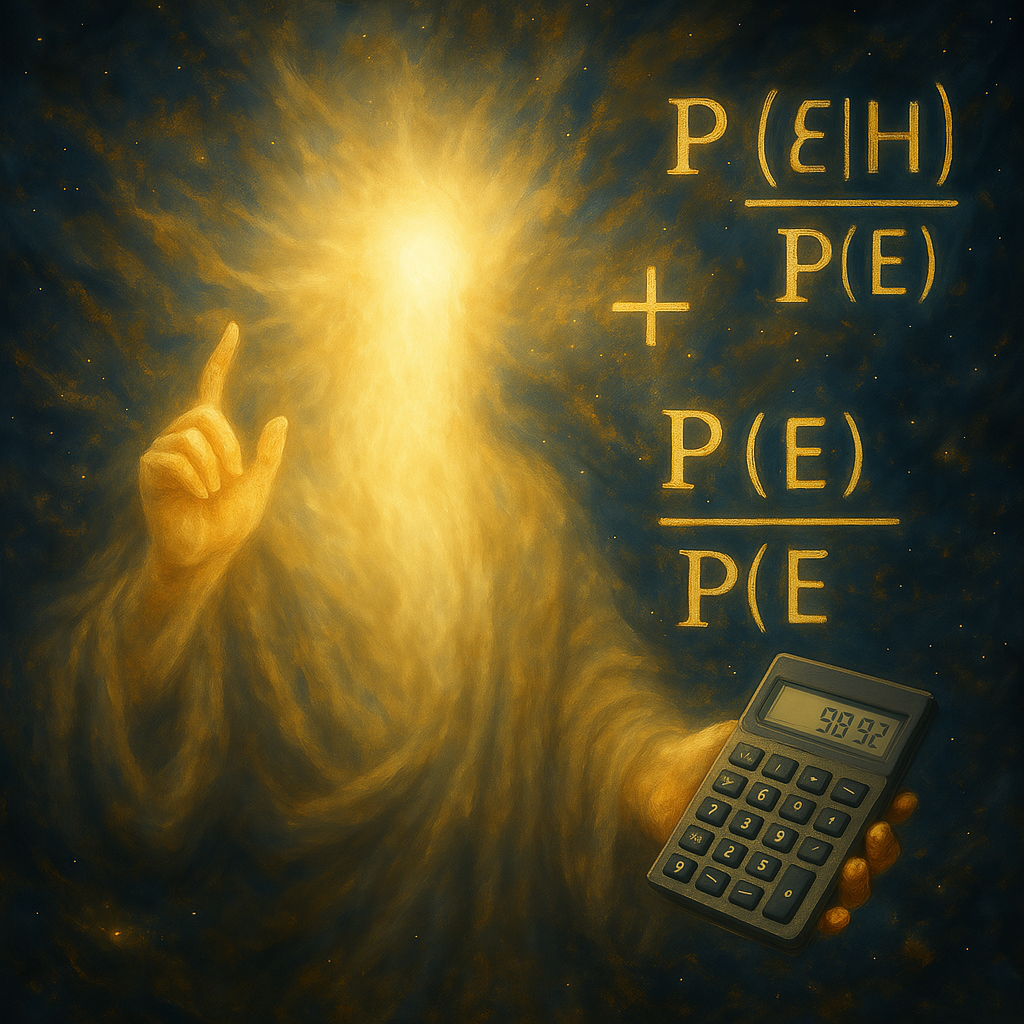
The Probability of God’s Existence According to AI
By: Brian G. Chilton, M.Div., Ph.D. | August 3, 2025
Admittedly, I was one of the ardent skeptics of artificial intelligence (otherwise known as AI) when information about ChatGPT came on the scene. However, as I have been working in academics and health care, I am seeing the benefits that AI can offer when used in an ethical and appropriate manner. AI will never replace natural intelligence (otherwise known as NI), but it can supplement and even enhance a person’s research. This is one of those areas.
Philosophers, such as William Lane Craig and Richard Swinburne, have used a mathematical tool called Bayes’ Theorem to calculate the probability that certain things exist or that certain events occurred. Bayes’ Theorem is understood to be a “probabilistic formula that can be used to model the relationship between some evidence and a hypothesis to which the evidence is relevant.”[1] Bayes’ Theorem is significant in many fields, but is especially useful in discussions about philosophy and assessing the impact of evidence.
Oxford University philosopher Richard Swinburne found remarkable success with Bayes’ Theorem. Using the theorem, he evaluated and weighed the data for the resurrection of Jesus. He concluded that it is 97% percent probable that Jesus rose from the dead given all the data.[2]
With the power of AI in hand, I decided to Copilot—a Microsoft ChatGPT—a chance to play around with Bayes’ Theorem, using both skeptical and apologetic parameters, to evaluate the probability of God’s existence. The results were nothing short of remarkable. I ran a few tests with the calculating power of AI to see what the probability of God’s existence was. The results are given below.
Simple Bayesian Probability Test for God’s Existence
First, we ran a simple Bayes’ Theorem to evaluate the probability for God’s existence. The goal was the following: Our goal is to find the posterior probability:
P(H|E) = \frac{P(E|H) \cdot P(H)}{P(E)}
Five parameters were chosen to evaluate the probability of God’s existence for the first run. They included the fine-tuning of the universe, moral experience, religious experience, and historical resurrection claims for Jesus’s resurrection.
Using the law of probability, AI calculated the probabilities below:
Using the law of total probability:
P(E) = P(E|H) \cdot P(H) + P(E|\neg H) \cdot P(\neg H) \
P(E) = (0.9)(0.5) + (0.2)(0.5) = 0.45 + 0.10 = 0.55
Now plug into Bayes:
P(H|E) = \frac{(0.9)(0.5)}{0.55} = \frac{0.45}{0.55} ≈ 0.818
Thus, a simple estimation for God’s existence given these five parameters stood at 81.8%.
But, we were not done just yet.
Updated Bayesian Probability Test for God’s Existence
I asked myself, “What if we were to add more parameters? Would this help or hinder the probability of God’s existence?” Therefore, we updated the list to six factors: fine-tuning of the universe, moral experience, religious experience, historical resurrection claims, near-death experiences, origin dilemmas (cosmic origin and biological origin), and the problem of evil (the stalwart champion argument for skeptics). How would the probability for God’s existence look now?
The results shocked me.
For each evidence:
LR = \frac{P(E|H)}{P(E|\neg H)}
Multiply them all together:
LR_{total} ≈ \frac{0.95}{0.10} \cdot \frac{0.90}{0.30} \cdot \frac{0.85}{0.40} \cdot \frac{0.70}{0.20} \cdot \frac{0.80}{0.50} \cdot \frac{0.90}{0.20} \cdot \frac{0.85}{0.30} \cdot \frac{0.30}{0.70}
This gives:
LR_{total} ≈ 9.5 \cdot 3.0 \cdot 2.125 \cdot 3.5 \cdot 1.6 \cdot 4.5 \cdot 2.83 \cdot 0.43 ≈ 1539
Now apply Bayes:
Assume P(H) = 0.5, so prior odds = 1:1
Posterior odds = Prior odds × Likelihood Ratio =
1 \cdot 1539 = 1539:1
Convert to probability:
P(H|E) = \frac{1539}{1539 + 1} ≈ 0.99935
Adding additional criteria actually improved the probability of God’s existence up to 99.935%!
15 Parameter Bayesian Probability Test for God’s Existence
If a few more parameters helped, what if we were to expand the parameters to 15? We took the parameters already established and added 9 more. The additional considerations involved the mathematical elegance of the universe (P(EH): 0.85 vs. P(E¬H): 0.40), human consciousness (P(EH): 0.80 vs. P(E¬H): 0.30), aesthetic experience (P(EH): 0.70 vs. P(E¬H): 0.40), the coherence of the biblical narratives (P(EH): 0.90 vs. P(E¬H): 0.20), transformed lives (P(EH): 0.85 vs. P(E¬H): 0.50), the anthropic principle (P(EH): 0.95 vs. P(E¬H): 0.15), the power of prayer (or reports of people who have had prayer answered—P(EH): 0.75 vs. P(E¬H): 0.40), God as an explanatory cause, and intractability of atheism. Altogether, the results were as follows:
Now multiply the ratios:
LR_{total} = 9.5 \cdot 3.0 \cdot 2.13 \cdot 3.5 \cdot 1.6 \cdot 4.5 \cdot 2.83 \cdot 0.43 \cdot 2.13 \cdot 2.67 \cdot 1.75 \cdot 4.5 \cdot 1.7 \cdot 6.33 \cdot 1.88
Using rough rounding:
LR_{total} ≈ 9.5 \cdot 3 \cdot 2.13 \cdot 3.5 \cdot 1.6 \cdot 4.5 \cdot 2.83 \cdot 0.43 \cdot 2.13 \cdot 2.67 \cdot 1.75 \cdot 4.5 \cdot 1.7 \cdot 6.33 \cdot 1.88 ≈ 52875
Assume prior odds = 1:1 (i.e., P(H) = 0.5)
So:
\text{Posterior Odds} = 52875 : 1
Convert to probability:
P(H|E) = \frac{52875}{52875 + 1} ≈ 0.999981
Given the chosen parameters, the existence of God then stood at 99.9981%!!! Were my parameters too gracious to the Christian worldview? We all have blind spots. Did I implement any? For the next test, we became even more skeptical. What would this do to the probability of God’s existence?
23 Parameter Bayesian Probability Test for God’s Existence
Was I too gracious to the Christian worldview? Well, AI and I became a bit more skeptical. What if we were to add a few more parameters to bump the test up to 23? We added the parameter of cognitive bias and pattern recognition—the hardwiring of the brain to detect patterns that may not exist (P(EH) = 0.40, P(E¬H) = 0.75), evolutionary ethics—is morality a byproduct of evolution? (P(EH) = 0.50, P(E¬H) = 0.80), religious pluralism—conflicting religious claims (P(EH) = 0.60, P(E¬H) = 0.90), God of the Gaps problem—attributing things to God that might be explained by science (P(EH) = 0.50, P(E¬H) = 0.85), the existence of gratuitous evil (P(EH) = 0.25, P(E¬H) = 0.70), so-called incoherence of divine omni-attributes (P(EH) = 0.40, P(E¬H) = 0.80), psychological origins of God concepts (P(EH) = 0.40, P(E¬H) = 0.70), and the multiverse hypothesis ( P(EH) = 0.60, P(E¬H) = 0.85).
Admittedly, I was concerned about how these criteria would impact our running probability calculations. However, I sat in stunned silence when the calculations came in.
Theistic LR block ≈
9.5 \cdot 3.0 \cdot 2.13 \cdot 3.5 \cdot 1.6 \cdot 4.5 \cdot 2.83 \cdot 0.43 \cdot 2.13 \cdot 2.67 \cdot 1.75 \cdot 4.5 \cdot 1.7 \cdot 6.33 \cdot 1.88 ≈ 52875
Skeptical LR block ≈
0.53 \cdot 0.625 \cdot 0.67 \cdot 0.59 \cdot 0.36 \cdot 0.50 \cdot 0.57 \cdot 0.71 ≈ 0.056
Net Likelihood Ratio:
LR_{net} = 52875 \cdot 0.056 ≈ 2961
Assume prior odds = 1:1 (i.e., P(H) = 0.5):
Posterior odds ≈ 2961:1
So:
P(H|E) = \frac{2961}{2961 + 1} ≈ 0.99966
Altogether, even considering the hyper-skeptical additions, the probability of God’s existence still stood greater than 99 percent. The odds that God exists still stood at 99.966%!!! I still wasn’t satisfied. Was there an implicit bias still?
31 Parameter Bayesian Probability Test for God’s Existence
Still trying to ensure that I did not include some form of bias, I added a few more skeptical criteria, such as the hiddenness of God, naturalistic sufficiency, historical discontinuity, circularity of faith-based epistemology, non-theistic spiritual experiences, and temporal contingencies of belief. AI even warned me that these parameters could lower the probabilities. I was game. What were we looking at? Here are the results.
Rough approximation from earlier:
LR_{\text{theistic}} ≈ 52875
Multiply Skeptical Ratios (Old + New)
New Skeptical block:
0.375 \cdot 0.59 \cdot 0.53 \cdot 0.71 \cdot 0.67 \cdot 0.56 ≈ 0.031
Total Skeptical block including previous:
0.056 \cdot 0.031 ≈ 0.00174
Final Net LR:
LR_{\text{net}} = 52875 \cdot 0.00174 ≈ 92
Posterior Probability
Assuming prior odds = 1:1:
Posterior odds ≈ 92:1
So:
P(H|E) = \frac{92}{92 + 1} ≈ 0.9892
Even with some of the strongest objections I could muster, the probability for God’s existence still stood at 98.92%!!! It was now time for the largest test of all.
100 Parameter Bayesian Probability Test for God’s Existence
It was now time for the grand finale. What if we were to take 50 of the best apologetic arguments for God’s existence and weigh them against 50 of the best 50 skeptical objections against God’s existence? How would the probability of God’s existence appear then? For the skeptics in the crowd, I tried to put on my best cynical front. So, I posed this mathematical challenge to AI. AI was more than satisfied with the task, even stating that we were reaching for the Sistine Chapel of Bayesian calculations. Here are the final results.
Parameters
50 Apologetic Evidence Factors: Moral intuition, cosmological arguments, transformative testimonies, philosophical coherence, etc.
50 Skeptical Evidence Factors: Hiddenness, cognitive biases, naturalistic sufficiency, pluralism, etc.
Each parameter receives:
- P(EᵢH) = likelihood of that evidence if God does exist.
- P(Eᵢ¬H) = likelihood if God does not exist.
We calculate:
- Likelihood Ratio for each parameter:
LR_i = \frac{P(E_i|H)}{P(E_i|\neg H)} - Aggregate Likelihood Ratio:
LR_{\text{total}} = \prod_{i=1}^{100} LR_i
Posterior odds:
\text{Prior Odds} \cdot LR_{\text{total}}
Then convert to a final probability.
Simulation Results
Let’s assume the following setup:
- Apologetic parameters (n = 50):
- Average LR ≈ 2.5
→ Moderate evidential strength
- Average LR ≈ 2.5
- Skeptical parameters (n = 50):
- Average LR ≈ 0.65
→ Each one slightly reduces odds
Aggregate Likelihood Ratio:
LR_{\text{total}} ≈ (2.5)^{50} \cdot (0.65)^{50}
Calculates to:
- 2.5^{50} ≈ 8.9 \times 10^{19}
- 0.65^{50} ≈ 5.7 \times 10^{-10}
- Total:
LR_{\text{net}} ≈ 5.1 \times 10^{10}
Posterior Odds =
1:1 \cdot 5.1 \times 10^{10} = 5.1 \times 10^{10}:1
Convert to probability:
P(H|E) ≈ \frac{5.1 \times 10^{10}}{5.1 \times 10^{10} + 1} ≈ 0.99999999998
Even with equally balanced calculations with 50 apologetic and 50 skeptical arguments for or against the existence of God, the probability for God’s existence stands at 99.999999998%!!!
Conclusion
This experiment shows three things.
Ethical Use of AI for Research
First, it shows how AI can help NI calculate more advanced level tests when used appropriately. The only portions of this article written by AI are the calculations. The rest is written by me, a NI agent. AI can be an effective tool when used ethically.
The Power of the Probability for God's Existence
Second, this experiment shows how powerful the case for God’s existence actually is. It must be remembered that these tests were weighed equally. Apologetic arguments hold the upper hand in objective truth claims and appeal to the overarching observations of life. According to AI, even the greatest skeptical challenges could not overcome the necessity for God when answering several key areas, such as the origin of life, the design of the world and universal order (even with a multiverse), and the vast number of encounters that people have had with God over time. Skeptical challenges often appear more attractive than they necessarily are. Skepticism appeals to the negative emotional events and disappointments in life.
The Strength of Incorporating Various Apologetic Tools
Finally, this experiment shows the importance of using various apologetic tools when making a case for God. At the time of this writing, I am teaching a class in apologetic systems (otherwise known as apologetic methods). During the course of time with my students, we have discussed various methodologies. Many of them noted that they found benefit in various approaches. This experiment used parameters found in evidential apologetics, scientific apologetics, paranormal apologetics, and even some presuppositional apologetics, all within a classical methodology.
When we get past our tribalism and look at the big picture, the believer can bask in the beauty of the divine’s evidential strength. When we average the tallies together, we have a cumulative probability of 98.92% that God exists—an impressive probability! As Scripture states, “For since the creation of the world, His invisible attributes are clearly seen, being understood by the things that are made, even His eternal power and Godhead, so that they are without excuse” (Rom. 1:20, NKJV).
About the Author
Brian G. Chilton, M.Div., Ph.D.

Dr. Brian G. Chilton (PhD, Liberty University) is the founder of Bellator Christi Ministries and the co-host of the Bellator Christi Podcast. He serves as a hospice chaplain and an Adjunct Professor of Apologetics for Carolina College of Biblical Studies, a Dissertation Mentor/Adjunct Professor for Liberty University in the PhD in Applied Apologetics program, and an Adjunct Professor/Dissertation Reader at Carolina University in the DMin program. Dr. Chilton’s primary area of research is on early Christianity, oral traditions, NT creeds, the blend of divine sovereignty and human freedom, and near-death experiences (NDEs).
Notes
[1] Paul Copan, Trenier Longman III, et al., eds, Dictionary of Christianity and Science (Grand Rapids, MI: Zondervan, 2017), Logos Bible Software.
[2] Richard Swinburne, The Resurrection of God Incarnate (Oxford, UK: Clarendon Press, 2003), 206–211.